
Coupons vs Promo Codes vs Deals: What They Mean and How to Use Each One
You have probably seen all three terms on the same page. A banner says “Save 20% with this coupon,” a pop up asks you to enter a promo code, and a product tile shouts “Deal of the day.” They sound like the same thing, and plenty of websites use them interchangeably. But they are not identical, and knowing the difference can change how much you actually save when you shop online.
This guide breaks down the main types of online discounts in plain language. You will learn what coupons, promo codes and deals really are, how each one works at checkout, where shoppers usually find them, and how to avoid the common traps. We will also look at how online discounting has been shifting in 2026, so you can shop with a realistic picture of what is available today.

The Short Answer: How Coupons, Promo Codes and Deals Differ
If you only have thirty seconds, here is the simplest way to think about it.
- A coupon is a promotional offer that gives you a discount or other benefit on a product or purchase. It may be a printable coupon, a digital coupon you activate, a scannable offer, or a link that applies the saving automatically.
- A promo code is a string of letters and numbers that you type into a box at checkout to unlock a discount.
- A deal is a special price, promotion or offer that is usually presented directly on the product or shopping page. You may not need to enter anything, although some deals can also require a code or other action.
In practice, the lines blur. A website might call a promo code a “coupon code,” and a store might promote a sale as a “deal” even though it also requires a code. What matters is the action you need to take to receive the saving. The table below shows the usual pattern.
| Feature | Coupon | Promo Code | Deal |
|---|---|---|---|
| What you do | Clip, print, scan or activate | Type a code at checkout | Buy at the listed price |
| Typical savings format | Amount off, percentage off, free item | Percentage off, amount off, free shipping | Reduced price, bundle, buy one get one |
| Where you find it | Store apps, newsletters, coupon sites, packaging | Emails, social posts, creators, coupon sites | Retailer homepages, sale pages, deal sites |
| Usually limited by | Product, store or expiry date | Order value, first time customers, expiry date | Time window or stock levels |
| Can it be stacked? | Sometimes | Often restricted | Often combines with a code, but not always |
What Is a Coupon?
Coupons have been used for decades, and the basic idea remains simple. A retailer or brand gives shoppers a specific offer that reduces the cost of a purchase.
Manufacturer Coupons
These come from the brand that makes the product, not the store selling it. A cereal company, for example, might issue a coupon for a dollar off a particular box. The retailer may accept the coupon and receive reimbursement from the manufacturer under the relevant coupon program. Manufacturer coupons are common in grocery, household goods, health and beauty, and pet supplies.
Store Coupons
Store coupons are issued by the retailer itself and can usually only be used at that retailer. They often cover a whole basket, such as ten dollars off a forty dollar order, or a percentage off a category like shoes or home decor. Many big retailers send these through email, text messages or their shopping apps.
Digital and Clippable Coupons
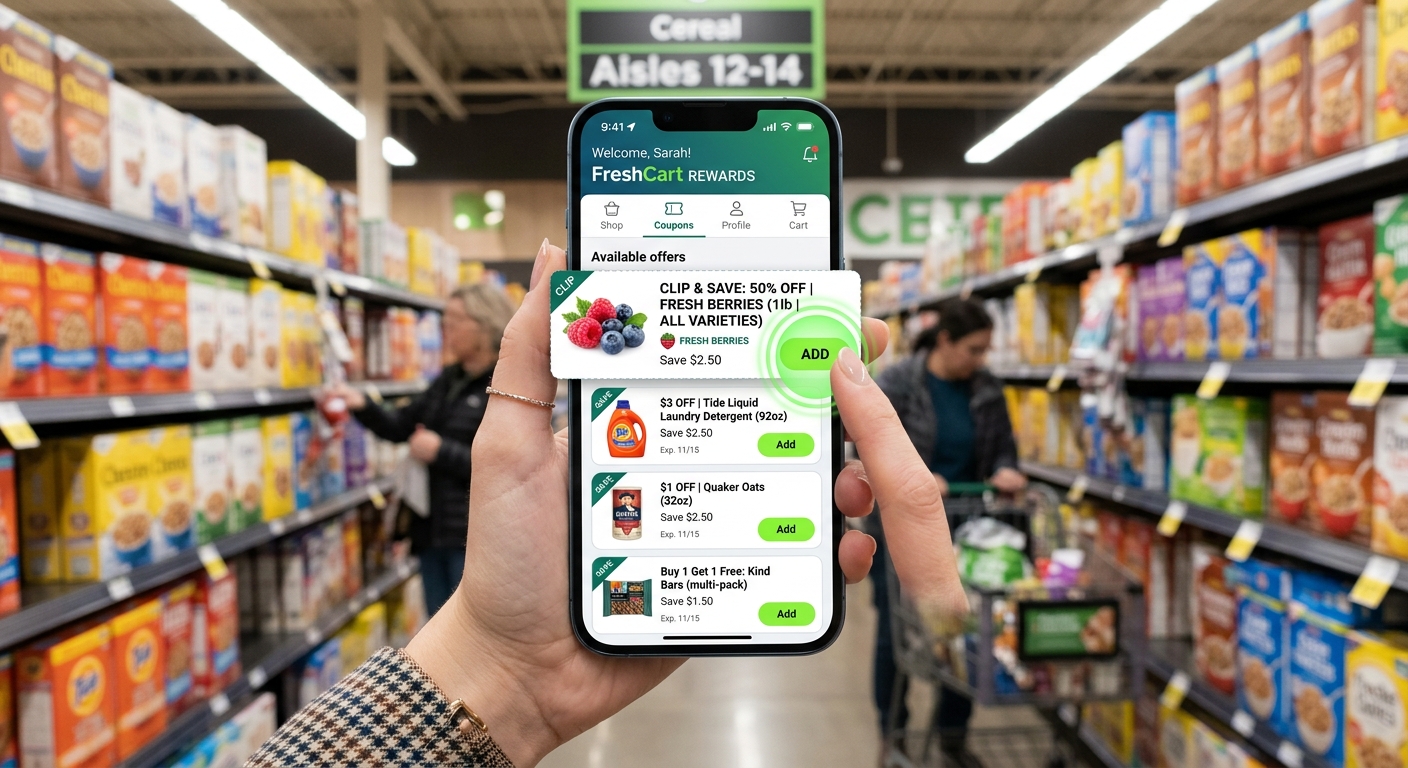
Digital coupons have become the default for many grocery chains and drugstores. You browse a list of offers in an app or on the retailer’s website, tap to add the ones you want to your account, and the savings apply automatically when you scan your loyalty number or phone number at the register. Online, the same idea works through a “clip” button on the product page.
The main benefit is convenience. The main drawback is that you have to remember to activate the offer before you pay. Plenty of shoppers lose out simply because they forgot to tap the button.
Printable Coupons
Printable coupons still turn up on brand websites and coupon platforms. They tend to have barcodes, expiry dates and strict limits, so read the fine print before you head to the store. Retailers are generally cautious about altered or copied coupons, so only use ones downloaded directly from a trusted source.
When Coupons Make the Most Sense
- When you already plan to buy a specific product and a coupon exists for it.
- When you shop regularly at one retailer that has a strong app or loyalty program.
- When you buy everyday items such as groceries, toiletries or pet food, where small savings repeat week after week.
What Is a Promo Code?
A promo code, sometimes called a discount code, coupon code or voucher code, is a short combination of letters and numbers that you enter in a box during online checkout. When the code is accepted, the system adjusts your total. Codes are the backbone of online discounting because they are easy for retailers to create, track and limit.
A typical code looks like WELCOME15 or FREESHIP. The retailer can decide how many times it can be used, who can use it, which products it applies to and when it expires. That flexibility is why marketers love them.
Common Types of Promo Codes
- Percentage off codes: Take a set percentage off your order, such as 10% or 25%.
- Fixed amount codes: Remove a set amount, such as twenty dollars off an order above one hundred.
- Free shipping codes: Waive delivery fees, sometimes only above a minimum spend.
- First order codes: Offered to new customers, often in return for signing up to an email list.
- Referral codes: Shared by existing customers, usually giving both the sender and the friend a reward.
- Influencer and partner codes: Created for a specific creator, publication or community, which lets the brand see where sales come from.
- Single use codes: Unique to one customer and often sent privately, such as a birthday or cart reminder offer.
Where Shoppers Find Promo Codes
The most reliable source is always the retailer itself. Check the website banner, the email signup offer, the order confirmation page and the brand’s social media accounts. Beyond that, coupon and deal websites, newsletters, creator videos and community forums are common places where codes are shared.
Be realistic about expectations. Not every code listed online works. Codes expire, hit usage limits, or only apply to certain products. A good coupon website will show when a code was last verified, but even then, a code may stop working without notice.
Why Promo Codes Sometimes Fail
If you have ever typed a code and received an error, you are in good company. The usual reasons are:
- The code has expired or reached its redemption limit.
- Your cart does not meet the minimum spend.
- The items in your cart are excluded, which often includes sale items, gift cards or certain brands.
- The code is for new customers only and your email address is already in the system.
- The code cannot be combined with another offer that is already active.
- You typed it incorrectly. Some checkout systems are sensitive to capitalization, formatting or extra spaces, so enter the code exactly as provided.
Before giving up, read the terms linked beside the offer. They usually explain exactly why a code did not apply.
What Is a Deal?
Unlike “coupon” and “promo code,” the word “deal” does not describe one specific discount mechanism. Retailers use it as a broad term for an attractive price, promotion or opportunity to save. A deal may be automatic, or it may require a coupon, promo code, membership or another action.
Popular Types of Online Deals
- Flash sales: Short, time limited price cuts that may last a few hours or a day.
- Daily deals: Featured products that change regularly, often highlighted on a retailer’s homepage.
- Clearance and end of season sales: Reduced prices on older stock or items leaving the range.
- Bundle deals: Several items sold together for less than the individual prices combined.
- Buy one get one offers: A second item free or discounted when you buy the first.
- Seasonal sales: Large campaigns around events like Black Friday, Cyber Monday, back to school, Prime Day style events and end of year sales.
- Open box and refurbished deals: Lower prices on returned or restored items, commonly in electronics.
The Advantage of Deals
Deals are simple. There is no code to forget and no condition to decode. The price you see is the price you pay. For shoppers who value speed, this is appealing.
The Catch With Deals
Because deals are so visible, they are also where marketing can get slippery. A “was” price may not reflect what the product usually sells for, and a countdown timer does not always mean the offer will actually disappear. Consumer protection authorities in several markets have warned about misleading reference prices, countdown timers and other discount claims, so it is sensible to check the price history of a product before you decide something is a bargain. Price tracking tools and a quick comparison across a few retailers take only a minute.
Other Online Discount Types Worth Knowing
Coupons, codes and deals are the headline acts, but several other types of savings often appear in the same shopping journey. Knowing them helps you build a stronger savings routine.
Cashback
Cashback programs return a percentage of what you spend after you buy. You usually activate the offer through a portal, app or browser extension, then complete the purchase. The money is credited to your account after a confirmation period and can often be withdrawn or used as a credit. Terms vary, and some purchases may not qualify, so it helps to read the rules first.
Loyalty and Rewards Programs
Many retailers reward repeat customers with points, tiers or members only pricing. Over time, the points can be redeemed for discounts or free items. These programs work best when you already shop with the brand regularly. Signing up for several programs just to chase small rewards is rarely worth the clutter.
Student, Teacher and Group Discounts
Brands frequently offer reduced prices for students, educators, healthcare workers, military members, first responders and seniors. Eligibility is normally confirmed through a verification service or proof of status. If you belong to one of these groups, check the retailer’s discounts page before you buy.
Referral Rewards
When you share a referral link or code with a friend, both of you may receive a credit. This is common with subscription services, delivery apps, banks and direct to consumer brands. Only share links with people who would genuinely benefit from the product, and follow the program’s rules.
Price Matching and Price Adjustment
Some retailers will match a competitor’s lower price on an identical item, or refund the difference if the price drops soon after you buy. Policies differ widely, with plenty of exclusions, so check the fine print before relying on it.
Credit Card and Payment Offers
Certain credit cards, debit cards and digital wallets feature merchant offers, such as a statement credit after spending at a selected retailer. These can be useful, but they are only worth taking if you would have made the purchase anyway. Spending extra to earn a reward rarely adds up.
Coupons vs Promo Codes vs Deals: Which One Saves You the Most?
There is no universal winner, because the best option depends on what you are buying and how you shop. Here is a practical way to think about it.
Choose Coupons When You Buy Regularly From the Same Place
Grocery, pharmacy and household shopping tend to benefit most from digital coupons, because the savings repeat. A few minutes of clipping each week can build up over a year.
Choose Promo Codes When You Are Making a Larger Online Purchase
Clothing, electronics, furniture, travel and subscription services frequently advertise promotional codes or other checkout offers. Since the order value is higher, even a modest percentage off can mean a meaningful amount saved. A quick search before checkout is usually worth it.
Choose Deals When Timing Is Flexible
If you can wait for a sale season or are open to a particular product being discounted, deals can deliver bigger reductions than coupons or codes. Patience matters here.
Combine Them Where the Rules Allow
The strongest savings often come from using more than one method. You might buy a product that is already on sale, apply a first order promo code, pay through a cashback portal and earn loyalty points on the same purchase. Not every retailer allows this, so check the terms before assuming it will work.
Online Discount Trends to Watch in 2026
The way retailers use discounts keeps evolving. Here are the patterns most shoppers and marketers are noticing as of mid 2026. Exact numbers vary by industry and region, so treat these as directional trends rather than fixed rules.
More Offers Are Moving Into Apps and Accounts
More retailers are moving some offers into apps and customer accounts. This gives them direct customer data and a way to personalize what each shopper sees. The result is that some of the best offers are no longer posted publicly. If you shop with a brand often, having an account and notifications switched on can reveal offers you would otherwise miss.
Personalized Offers Are Becoming Normal
Rather than blasting one code to everyone, Some brands use customer activity, purchase history or account information to tailor the offers they present. A friend might receive a different discount than you do for the same item. This is a good reason to compare offers instead of assuming yours is the best available.
AI Shopping Assistants Are Changing Discovery
Search engines, shopping platforms and retail apps are increasingly adding AI powered tools that can summarize products, compare options and help shoppers decide where to buy. These tools can speed up research, but they may not always reflect the latest price, promotion or stock information. Confirm important details on the retailer’s own site before you buy.
Stricter Rules Around Stacking and Abuse
Many retailers now allow only one code per order and block automatic code testing.
Greater Attention to Transparency
Consumer protection authorities in several markets are paying closer attention to discount claims, reference prices, urgency tactics and other online pricing practices. For shoppers, this is positive. For publishers and coupon sites, it means being clear about how offers are verified and when a link may earn a commission.
How to Find Legitimate Discounts Online
Finding a working offer is easier when you follow a simple routine. Here is one that works for most purchases.
- Start with the retailer. Check the homepage banner, the sale or offers page, and any signup incentive. Many stores give a welcome discount for joining their email list.
- Check the app. Some offers exist only in the mobile app, especially for grocery and fashion brands.
- Look at a trusted coupon website. Choose sites that show verification dates, explain terms clearly and do not bury the page in pop ups.
- Compare prices elsewhere. A deal is only good if the final price beats other stores. Look at the total including shipping and tax.
- Consider cashback. If you were going to buy anyway, activating a cashback offer first adds a layer of savings.
- Read the terms before you pay. Look at exclusions, minimum spend, expiry dates and return policies.
Signs an Offer Is Trustworthy
- It is posted on the retailer’s official website, app or verified social accounts.
- The terms are clear, including dates, exclusions and limits.
- The coupon website displays a recent verification date and explains how it checks offers.
- The discount seems realistic for the brand and product category.
Can You Stack Coupons, Promo Codes and Deals?
Sometimes, but not always. Stacking means using more than one discount on the same order. Policies vary by retailer, and they can change during sales events.
Here is what commonly applies:
- Many stores allow only one promo code per order.
- A sale price can often be combined with a code, but clearance items are frequently excluded.
- Cashback can sometimes be combined with other offers, but the rules vary by cashback provider and retailer. Some programs exclude purchases made with certain promotional codes.
- Loyalty points can generally be earned even when you use a code, though some brands exclude discounted items.
- Manufacturer coupons and store coupons may be combined at some grocery retailers, but policies differ by chain and by country.
When in doubt, check the retailer’s coupon policy page or the terms shown beside the offer. If it is still unclear, customer support can answer in a minute or two.
Common Mistakes That Cost Shoppers Money
Buying Something You Did Not Need
A discount only saves money if you would have bought the item anyway. A thirty percent reduction on something you did not plan to purchase is still money spent.
Ignoring the Total Cost
Free shipping thresholds can push shoppers to add items they do not need. Compare the final price with and without the extra item, and do not forget return costs.
Trusting Unverified Codes
Random codes posted in comment sections or on unfamiliar pages are often expired, and some pages exist only to collect clicks. Stick with trusted sources and be cautious about sites that ask for unnecessary personal details.
Forgetting to Activate the Offer
Digital coupons and cashback offers often need activation before checkout. Do it first, then purchase in the same session where possible, and avoid switching between apps or tabs that might interrupt tracking.
Missing the Expiry Date
Offers can end sooner than you expect, particularly during busy sales periods. If you plan to buy, check the date and the time zone.
How to Avoid Coupon and Deal Scams
Where there is demand for discounts, there are people trying to exploit it. A few simple habits keep you safer.
- Be careful with offers that arrive through unexpected messages promising unusually large discounts or free products.
- Never share your password, payment details or verification codes to claim a coupon. A genuine offer will not need them.
- Check the web address carefully before entering information. A secure connection is important, but HTTPS alone does not prove that a website is legitimate.
- Avoid downloading unknown browser extensions or software that claims to find unlimited codes. Review permissions and reviews before installing anything.
- If an offer seems too generous to be real, visit the retailer’s official site directly instead of clicking a link.
If you suspect you have encountered a scam, contact your bank or card provider and report it to the retailer and your local consumer protection authority.
Tips for Getting the Best Value Every Time
- Join the email lists of the stores you shop at most, then use a separate address if you worry about inbox clutter.
- Add items to your cart and wait. Some retailers follow up with a small incentive, though this is not guaranteed.
- Plan larger purchases around known sale periods when it is practical.
- Use price tracking tools for expensive items such as electronics and appliances.
- Keep a short list of your favorite stores and check their offers pages before every purchase.
- Review return policies. A discount is not much of a bargain if returning the item is difficult or costly.
Frequently Asked Questions
What is the difference between a coupon and a promo code?
A coupon is generally an offer you clip, print or activate that reduces the price of a specific item or order. A promo code is a combination of letters and numbers you type into a box at online checkout. Many websites use the terms interchangeably, so the safest approach is to read the instructions that come with the offer.
Are promo codes and discount codes the same thing?
In most cases, yes. Promo code, discount code, coupon code and voucher code all describe a code entered at checkout to reduce your total. Different regions and retailers simply prefer different names.
Is a deal better than a coupon?
Not necessarily. A deal is useful because the discount is already applied, which saves effort. A coupon or code may offer a larger reduction, but it often comes with conditions. Comparing the final price is the only reliable way to know which is better for a specific purchase.
Why is my promo code not working?
Common reasons include expiry, minimum spend requirements, excluded products, first time customer restrictions and typing errors. Some codes also cannot be combined with other offers. Check the terms listed with the code and make sure your cart meets the conditions.
Can I use more than one promo code on the same order?
Most online stores allow only one promo code per order, although there are exceptions. Some retailers let you combine a code with a sale price, loyalty points or cashback. The retailer’s policy page will tell you what is permitted.
Do coupon websites really work?
Many do, but quality varies. Reliable coupon sites verify offers regularly, show dates and make the terms easy to understand. Because codes can expire quickly, there is no guarantee that every listed offer will work at the time you shop.
Is cashback the same as a coupon?
No. A coupon reduces the price at the time of purchase. Cashback returns a portion of your spend after the purchase has been confirmed. The two can sometimes be used together, depending on the program and retailer.
When are the best times of year to find online deals?
Large retail events such as Black Friday, Cyber Monday, end of year sales, back to school periods and major seasonal sales are popular times for discounts. Retailers also run clearance events at the end of each season. Timing and availability vary by country and category, so it helps to follow your preferred stores.
Are discount codes safe to use?
Codes from a retailer’s official channels are generally safe. Be careful with codes from unknown sources, and never provide sensitive information such as passwords to claim a discount.
Final Thoughts
Coupons, promo codes and deals all aim to do the same thing, which is to help you pay less. The difference lies in how you receive the discount and what conditions come with it. Coupons can be particularly useful for routine shopping, promo codes can deliver meaningful savings on larger online orders, and deals can be attractive when you have flexibility around timing or product choice.
The smartest approach is to stay curious and a little skeptical. Check the retailer first, compare the final price, read the terms and combine offers when the rules allow it. Do that consistently, and the savings tend to add up without much extra effort.
Comments (0)