
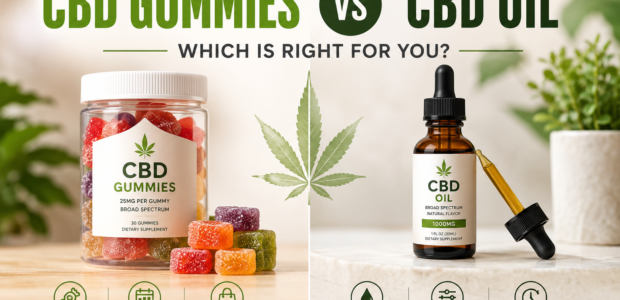
If you have spent any time browsing a wellness aisle or scrolling through a CBD brand’s website, you have probably noticed two products showing up over and over: little glass bottles of CBD oil and brightly colored bags of CBD gummies. Both are everywhere in 2026, and both claim to do roughly the same thing, so it is fair to wonder which one actually makes more sense for you.
The honest answer is that there is no universal winner. CBD oil and CBD gummies are made from the same plant compound, but they behave very differently once they enter your body. One absorbs faster. One lasts longer. One is easier to dose precisely, and one is easier to take without anyone noticing. This guide breaks down the real differences, backed by what current research and 2026 industry data tell us, so you can decide which format actually fits your routine.

What Is CBD and How Does It Work?
CBD, short for cannabidiol, is a naturally occurring compound found in the hemp plant. Unlike THC, CBD is not intoxicating, meaning it will not produce a high. It is typically extracted from hemp and then formulated into oils, gummies, capsules, topicals, and beverages.
Once consumed, CBD is thought to interact with the body’s endocannabinoid system, a network of receptors involved in regulating things like mood, sleep, pain perception, and inflammation. Research into exactly how CBD interacts with this system is ongoing, and while early studies are promising for certain uses, CBD is not an approved treatment for any medical condition aside from a small number of prescription-only formulations used for specific seizure disorders. Most over-the-counter CBD products are sold as wellness or supplement items, and any claims about treating, curing, or preventing disease should be treated with healthy skepticism.
With that groundwork in place, let’s get into how gummies and oil actually compare.
Full Spectrum, Broad Spectrum, or Isolate: It Matters for Both Formats
Before comparing gummies and oil head to head, it helps to understand that both formats can be made from three different types of hemp extract, and this affects the experience more than the delivery method does in some cases.
- Full-spectrum CBD contains CBD along with the full range of naturally occurring cannabinoids, terpenes, and flavonoids found in hemp, including trace amounts of THC, generally below 0.3 percent. Many people prefer full-spectrum products for what is sometimes called the entourage effect, the idea that these compounds may work better together than in isolation, though research on this is still developing.
- Broad-spectrum CBD offers a similar range of compounds but has the THC removed during processing. This appeals to people who want the potential benefits of multiple hemp compounds without any detectable THC.
- CBD isolate is pure CBD with everything else stripped away. It is flavorless and odorless on its own, which is one reason isolate is popular in gummies where a clean taste matters, though it is also commonly used in oils.
Both gummies and oil are available in all three forms, so the gummy versus oil decision and the full-spectrum versus isolate decision are really two separate choices that you can mix and match based on your priorities, including whether avoiding all THC is important to you.
CBD Market Trends Shaping 2026
The CBD industry has matured quite a bit over the past few years, and a handful of trends are worth knowing about as you shop in 2026.
- Continued market growth. Industry analysts have projected the global CBD market to surpass 20 billion dollars in value by the end of 2026, with steady growth expected to continue through the rest of the decade as more consumers move from curiosity to regular use.
- Ingredient pairing is on the rise. Formulators are increasingly combining CBD with complementary ingredients such as melatonin for sleep-focused gummies, or L-theanine and ashwagandha for calm-focused blends, rather than selling CBD on its own.
- Better absorption technology. Water-soluble and nano-emulsified CBD formulations are becoming more common in both oils and gummies, aiming to improve how much CBD the body actually absorbs.
- Tighter regulatory scrutiny. Regulators have sharpened their focus on accurate labeling, child-resistant and non-child-appealing packaging, and a crackdown on unapproved health claims, which is generally good news for consumers looking for trustworthy products.
- Expansion beyond humans. Pet-focused CBD products, particularly oils and chews for dogs and cats, have continued to grow as a category, reflecting wider interest in hemp-derived wellness products across the household.
None of these trends change the core gummies-versus-oil decision, but they do mean the products on shelves today are generally more refined and better tested than what was available even two or three years ago.
CBD Gummies vs CBD Oil: Quick Comparison
Here is a side-by-side snapshot before we go deeper into each category.
| Factor | CBD Gummies | CBD Oil |
|---|---|---|
| Onset time | 30 minutes to 2 hours | 15 to 45 minutes |
| Estimated bioavailability | Roughly 4% to 20% | Roughly 13% to 35% |
| Duration of effects | 6 to 8 hours or longer | 4 to 6 hours |
| Dosing precision | Fixed dose per piece | Adjustable by the drop |
| Taste | Sweet, flavored, masks hemp taste | Earthy or grassy, unless flavored |
| Portability | Very easy, no mess | Requires a dropper, less discreet |
| Typical cost per mg of CBD | Usually higher | Usually lower |
Now let’s unpack what each of these factors actually means for your day-to-day experience.
What Are CBD Gummies?
CBD gummies are chewable edibles infused with a measured dose of CBD, usually somewhere between 5 mg and 50 mg per piece. They come in countless shapes, flavors, and formulations, including options that combine CBD with melatonin for sleep, or with other botanicals like L-theanine for relaxation.
How CBD Gummies Are Made
Manufacturers typically start with a CBD extract, often CBD isolate or broad-spectrum hemp extract, and blend it into a gummy base made from gelatin or pectin, sugar, flavoring, and coloring. Because the dose is mixed evenly into the batch before the gummies are cut or molded, each piece should, in theory, contain a consistent amount of CBD. Reputable brands verify this with third-party lab testing, which is something worth checking before you buy.
Pros of CBD Gummies
- Pre-measured dosing takes the guesswork out of how much CBD you are consuming.
- No dropper, no measuring, no mess. You can take one anywhere without drawing attention.
- The sweet, fruity flavor makes them far more palatable than unflavored hemp extract.
- Effects tend to last longer, which some people find useful for sustained, all-day support.
- Travel-friendly and easy to portion into a daily pill organizer or bag.
Cons of CBD Gummies
- Because they pass through the digestive system, a larger portion of the CBD is broken down before it ever reaches your bloodstream.
- Onset is noticeably slower, so they are not the best choice if you want quicker support.
- Dosing is locked to whatever the gummy contains. Cutting one in half is messy and imprecise.
- Added sugar and calories may be a consideration for people watching their intake.
- Generally cost more per milligram of CBD than oil.

What Is CBD Oil?
CBD oil, often called a tincture, is a liquid extract of CBD suspended in a carrier oil such as MCT (coconut-derived) oil, hemp seed oil, or olive oil. It usually comes in a small glass bottle with a dropper for measuring doses.
How CBD Oil Is Used
The most common method is sublingual: a few drops are placed under the tongue and held there for around 30 to 90 seconds before swallowing. This allows some of the CBD to be absorbed directly through the mucous membranes in the mouth, bypassing a portion of the digestive process. CBD oil can also be swallowed directly, added to food or drinks, though doing so shifts the absorption profile closer to that of an edible.
Pros of CBD Oil
- Higher estimated bioavailability compared with edibles, meaning more of the CBD you take is likely to be used by your body.
- Faster onset, generally within 15 to 45 minutes when taken sublingually.
- Highly flexible dosing. You can adjust your serving by a single drop at a time, which is useful when you are still finding your ideal amount.
- Often more cost-effective per milligram than gummies.
- Can be added to drinks or food if the taste is an issue, though this changes the absorption speed.
Cons of CBD Oil
- The natural hemp flavor is earthy and slightly bitter, which some people find unpleasant even with added flavoring.
- Less discreet to use in public settings since it involves a dropper.
- Effects tend to wear off sooner than with gummies.
- Measuring drops accurately takes a little practice, especially with thicker oils.
- Bottles can spill or leak if not stored carefully, particularly while traveling.

Bioavailability and Onset Time: The Science Behind Absorption
Bioavailability refers to the percentage of a substance that actually reaches your bloodstream and becomes available to your body, rather than being broken down or excreted unused. This is the central reason CBD oil and CBD gummies feel different in practice, even at the same labeled dose.
When you swallow a gummy, the CBD travels through your stomach and digestive tract before passing through the liver, a process known as first-pass metabolism. A meaningful portion of the CBD is metabolized during this stage before it ever reaches general circulation. Research estimates oral bioavailability for edibles at roughly 4% to 20%, which is why some people feel gummies are a bit more unpredictable in their effects from one person to the next.
Sublingual administration, the method used with CBD oil, allows a portion of the CBD to absorb directly through capillary-rich tissue under the tongue, partially bypassing that first-pass liver metabolism. Estimates for sublingual bioavailability commonly fall between 13% and 35%, though this can vary depending on how long the oil is held under the tongue and individual differences in physiology.
It is worth noting that bioavailability research on CBD is still a developing area, and figures vary across studies and product formulations. Newer technologies like water-soluble or nano-emulsified CBD are being developed specifically to try to improve absorption in both gummies and oils, so this gap may narrow as formulation science advances.
Why Onset Time Matters
If you are looking for something to take before a stressful meeting or a flight, the 15 to 45 minute onset window of CBD oil is generally going to feel more responsive than waiting up to two hours for a gummy to kick in. On the other hand, if you are using CBD as part of a steady daily wellness routine rather than for an immediate need, the slower onset and longer duration of gummies might actually be an advantage.
Dosing: Which One Gives You More Control?
CBD oil wins on flexibility. Most tinctures come with a dropper marked in milliliters, and the bottle label tells you roughly how much CBD is in a full dropper. This makes it simple to start low, perhaps 5 to 10 mg, and gradually adjust upward in small increments until you find an amount that feels right for you.
Gummies, by contrast, come in fixed amounts. A 25 mg gummy is always 25 mg. If that turns out to be more than you need, your only real options are to cut the gummy (which is imprecise) or simply take it less often. For people who already know their preferred dose and want consistency without measuring anything, this fixed format is actually a benefit rather than a drawback.
A reasonable approach many people use: start with CBD oil while you are still figuring out your ideal serving size, then switch to gummies of a matching strength once you know what works for you.
Taste and Convenience: The Everyday Experience
This is where personal preference plays the biggest role. Hemp extract has a naturally earthy, slightly bitter, almost grassy taste. Flavored oils help, but the underlying hemp note is often still detectable. Gummies, on the other hand, are formulated like candy, with fruity, sweet flavors specifically designed to mask any trace of hemp taste.
Convenience tends to favor gummies as well. There is no dropper to fumble with, no risk of spilling oil in a bag, and no need to count drops while you are out at dinner or in an airport. A gummy can be tossed in a pocket or pillbox and taken with zero attention drawn to it.
Cost Comparison: Which Gives You More for Your Money?
Generally speaking, CBD oil tends to be more cost-effective on a per-milligram basis. That is largely because gummies require additional manufacturing steps, packaging, flavoring agents, and sweeteners, all of which add to the production cost that gets passed on to you.
That said, price varies enormously by brand, extraction method, and whether the product is full-spectrum, broad-spectrum, or isolate-based. Full-spectrum products, which retain trace amounts of other hemp compounds alongside CBD, are sometimes priced higher due to the more complex extraction process. When comparing prices, it helps to calculate the cost per milligram of CBD rather than simply comparing bottle or bag prices, since serving sizes differ widely between brands.
Which One Should You Choose?
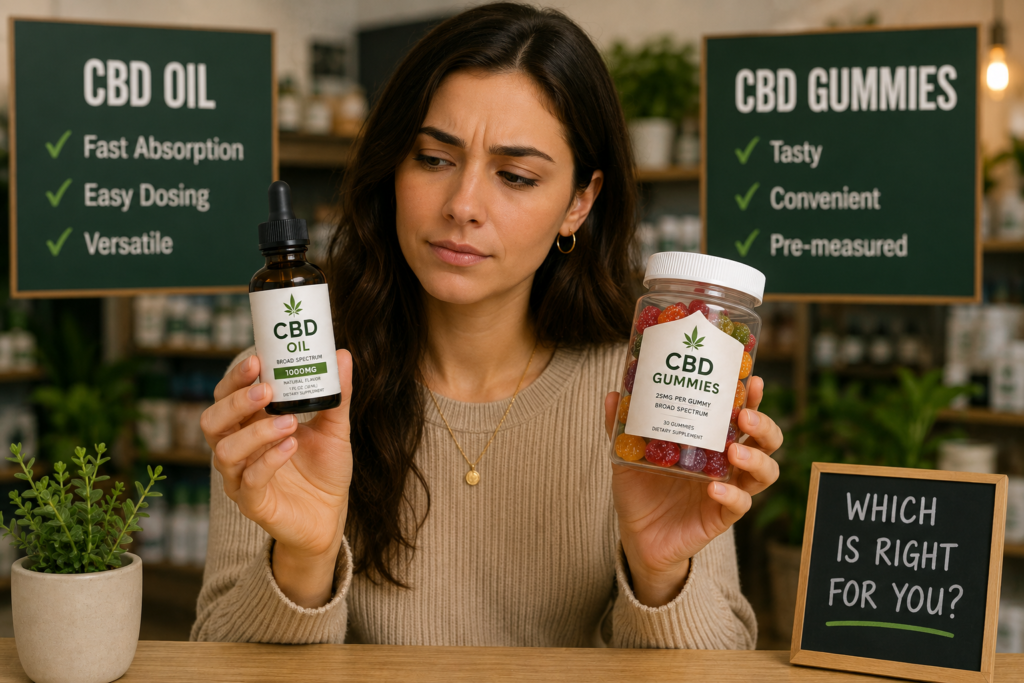
There is no single right answer here. It really comes down to your goals, lifestyle, and how your body responds. Here is a practical breakdown by use case.
If you want fast, responsive support
CBD oil taken sublingually is generally the quicker option, with effects that some people report noticing within 15 to 45 minutes. This may suit people who want CBD to fit into a specific moment, such as before a demanding task or in the evening as part of a wind-down routine.
If convenience and discretion matter most
CBD gummies are hard to beat for portability. No measuring, no taste issues, and no equipment needed. They are well suited to people who travel often or who simply prefer a grab-and-go format.
If you are new to CBD
CBD oil is often recommended for beginners because the adjustable dosing lets you start small and fine-tune your amount gradually. Once you have identified a comfortable range, transitioning to a gummy with a matching dose becomes much easier.
If you want long, steady support throughout the day or night
The slower release and longer duration associated with gummies may make them a more practical option for ongoing, all-day use, including as part of an evening routine. Some gummies are formulated specifically with sleep-supportive ingredients like melatonin for this reason.
Quality and Safety: What to Look for in 2026
The CBD market has grown substantially, and 2026 has brought some of the most significant regulatory shifts the industry has seen since hemp was first federally legalized in the United States. Whether you are buying oil or gummies, a few quality checks apply across the board.
Always Check for Third-Party Lab Testing
A trustworthy CBD brand should provide a Certificate of Analysis, often shortened to COA, from an independent lab. This document confirms the actual CBD content matches what is on the label and verifies the product is free from contaminants like heavy metals, pesticides, and residual solvents. If a brand cannot produce this documentation easily, that is a red flag.
Understand the Current Regulatory Landscape
In the United States, federal hemp regulation has been shifting throughout 2026. A new total THC standard tied to a recent appropriations measure is scheduled to take effect in November 2026, which is expected to change how some full-spectrum hemp products are classified and sold. Separately, the FDA has continued to focus enforcement on companies making unapproved disease-treatment claims about CBD, rather than on CBD use itself.
What this means practically for shoppers: hemp-derived CBD remains widely available and legal to purchase in most states, but the rules around THC content limits and labeling are evolving. It is worth checking your specific state’s current hemp laws, since they can differ from federal guidance, and choosing brands that are transparent about staying current with compliance requirements.
This article is intended for general informational purposes and is not legal or regulatory advice. Laws around hemp and CBD can change quickly, so confirm current rules in your state or country before purchasing, especially if you are subject to workplace drug testing.
Be Cautious With Health Claims
Be wary of any product or seller claiming CBD can cure, treat, or prevent a specific disease. No over-the-counter CBD product sold as a general wellness item has been approved by the FDA for treating any medical condition. Phrases like “may help support relaxation” or “commonly used for occasional stress” reflect how reputable brands should talk about their products. If you are managing a health condition or taking other medications, it is a good idea to speak with a healthcare provider before adding CBD to your routine, since CBD can interact with certain medications.
Can You Use CBD Oil and Gummies Together?
Yes, and plenty of people do. A common approach is using CBD oil for situational, faster-acting needs while keeping gummies on hand for convenience during travel or as part of a steady daily habit. There is nothing inherently wrong with using both formats, as long as you are tracking your total daily CBD intake across products so you do not unintentionally exceed the amount you are comfortable with.
Common Mistakes People Make When Choosing CBD Products
- Skipping the lab report. Always look for current, batch-specific third-party testing before buying either format.
- Expecting instant results from gummies. Edibles take time to process through digestion, so patience matters.
- Not holding oil under the tongue long enough. Swallowing it immediately reduces the sublingual absorption advantage.
- Choosing dose based on price alone. A cheaper product with a low milligram count per serving may actually cost more per milligram than a pricier alternative.
- Ignoring full-spectrum versus isolate differences. Full-spectrum products contain trace cannabinoids, including minimal THC, which may matter for people facing drug testing.
- Starting with too high a dose. Most guidance suggests starting low and increasing gradually rather than starting at a high serving size.
Frequently Asked Questions
Which works faster, CBD oil or CBD gummies?
CBD oil taken sublingually generally works faster, with some people reporting effects within 15 to 45 minutes. Gummies must be digested first, so onset is usually slower, often 30 minutes to 2 hours.
Is CBD oil stronger than CBD gummies?
Strength depends on the milligram dose, not the format itself. However, because oil generally has higher estimated bioavailability, a similar labeled dose of oil may feel more noticeable to some people compared with the same dose in gummy form.
Do CBD gummies show up on a drug test?
Standard drug tests screen for THC metabolites, not CBD. However, full-spectrum CBD gummies or oils contain trace amounts of THC, and regular use could theoretically contribute to a positive test in rare cases. If drug testing is a concern, a broad-spectrum or THC-free isolate product may be a safer choice, and checking the lab report for confirmed THC content is recommended.
How long do CBD gummies take to kick in?
Most people report noticing effects somewhere between 30 minutes and 2 hours after taking a gummy, since it needs to be digested before the CBD reaches the bloodstream.
Can I take CBD oil and CBD gummies on the same day?
Yes, many people combine both, but it is important to keep track of your total daily CBD intake across all products to stay within an amount you are comfortable with.
Are CBD gummies or CBD oil better for sleep?
Some people find gummies more practical for sleep support because of their longer duration of effect, particularly formulas that pair CBD with melatonin. Others prefer oil taken shortly before bed for a quicker onset. Individual response varies, so it may take some experimentation to see what works for you.
Is CBD legal in 2026?
Hemp-derived CBD with low THC content remains federally legal to purchase in most of the United States, though regulations are evolving, including a new total THC standard scheduled to take effect in November 2026. State laws can vary, so it is worth checking your local regulations, particularly if you live in a state with stricter hemp rules.
How do I know if a CBD product is high quality?
Look for a current Certificate of Analysis from an independent lab, clear labeling of milligram content per serving, transparent sourcing information, and a brand that avoids making specific disease-treatment claims.
Final Thoughts
CBD gummies and CBD oil are not competing products so much as two different tools designed for different moments. Oil offers speed and dosing precision, making it a strong fit for beginners or anyone who wants quick, adjustable support. Gummies offer convenience, better taste, and longer-lasting effects, making them ideal for people who want a no-fuss daily habit or something easy to carry around.
Rather than asking which one is objectively better, it is more useful to ask which one fits how you actually live. Some people settle on one format permanently. Others rotate between both depending on the day. Whichever you choose, prioritize brands that test their products through independent labs, clearly label milligram content, and avoid making unsupported health claims. That combination of transparency and quality matters far more to your experience than the format on the label.
Disclaimer: This article is for general informational purposes only and is not a substitute for professional medical or legal advice. Speak with a qualified healthcare provider before starting any new supplement, particularly if you are pregnant, breastfeeding, taking medication, or managing a health condition.