Skip to content

How to Save More Money Shopping Online Using Coupons and Deals

Online shopping has quietly turned into a game of patience and timing. Prices shift by the day, sometimes by the hour, and the difference between paying full price and paying half price often comes down to whether you paused for two extra minutes before hitting “buy now.” That pause is where coupons and deals come in.

By mid-2026, searching for a discount code before checkout has become such a normal habit that most shoppers do it without thinking twice. Retailers know this, and many have built entire pricing strategies around the assumption that a meaningful chunk of their customers will look for a coupon before finishing an order. If you are not doing the same, you are likely leaving money on the table every time you shop online.

This guide walks through practical, current ways to save more money shopping online using coupons and deals, from the basics of finding legitimate codes to the newer tactics shaped by mobile apps, browser extensions, and social commerce.

Why Coupons and Deals Still Matter in 2026

It would be easy to assume that with so much price transparency online, coupons would matter less than they used to. Instead, digital coupons have become a regular part of the online shopping experience, with retailers using targeted promotions, personalized offers, and limited-time discounts to encourage purchases. For shoppers, checking for a coupon or promo code before completing an order has become a simple way to look for additional savings. As online retailers continue to compete for price-conscious customers, coupons and deals remain an important part of how shoppers compare offers and decide when to buy.

A few things are driving this shift.

  • Mobile-first shopping. Mobile shopping has become a major part of online retail, pushing retailers toward app-only deals, push-notification flash sales, and one-tap checkout discounts.
  • Social commerce. Platforms like TikTok Shop, Instagram, and Facebook groups have become genuine discovery channels for deals, not just for products. Live shopping events, in particular, often include time-limited discount codes.
  • Loyalty and repeat business. Research on shopper behavior consistently shows that people are more likely to buy again from a brand that offers discounts and more likely to try a new brand because of a coupon.
  • Rising price sensitivity. With household budgets under pressure, more shoppers are treating coupon hunting as a normal part of the buying process rather than an occasional bonus.

None of this means you need to spend hours hunting for savings. It means a small, consistent set of habits can add up to real money saved over a year of online shopping.

What follows is not a list of gimmicks or one-time tricks that stop working after a season. These are habits that hold up regardless of which retailer you are shopping with, which device you are using, or which social platform happens to be trending this month. Some of them take thirty seconds. Others are more like small shifts in how you think about a purchase before you make it. Together, they are the difference between shopping reactively and shopping in a way that consistently works in your favor.

Understand the Different Types of Online Discounts

Before diving into strategy, it helps to know what you are actually looking for. Not all “deals” work the same way, and knowing the differences helps you spot the best one quickly.

Coupon Codes

These are alphanumeric codes entered at checkout, typically offering a percentage off, a fixed dollar amount off, or free shipping. They are the most common and most searched-for type of online discount.

Automatic Discounts and Sales

Some savings are applied automatically once you add an item to your cart or meet a spending threshold, no code required. These are often labeled “sale,” “clearance,” or “deal of the day.”

Cashback Offers

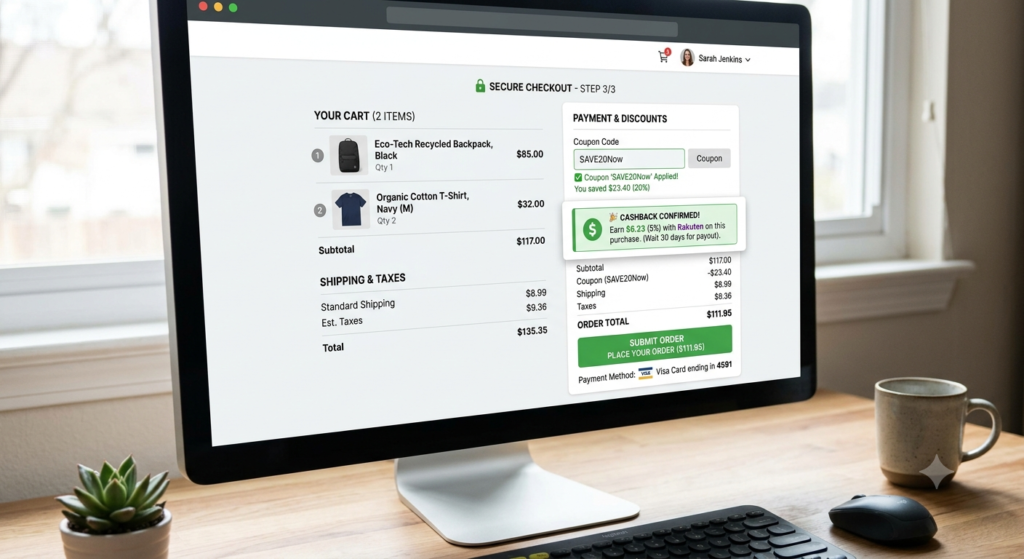
Rather than reducing the price at checkout, cashback returns a percentage of your purchase after the transaction, usually through a browser extension or shopping app. It can be combined with a coupon code in many cases.

Loyalty and Membership Discounts

Many retailers offer better pricing, early access to sales, or free shipping to members of a loyalty program or paid membership. These usually come with a trade-off of sharing more personal data or paying a subscription fee.

App-Exclusive Deals

An increasing number of retailers reserve their best discounts for shoppers who use their mobile app instead of the website. These deals often beat the standard site-wide coupon, but they can expire quickly and rely on push notifications.

Knowing these categories matters because the “best deal” is not always the flashiest one. A 15 percent coupon code might look less exciting than a bold “50% OFF” sale banner, but if that sale banner only applies after you spend a threshold you were not planning to reach, the coupon code is the better deal in practice. Getting comfortable reading past the headline discount and into the actual terms is one of the simplest ways to avoid a false bargain.

Where to Find Legitimate Coupons and Deals

The internet is full of outdated or fake coupon codes, so knowing where to look matters as much as knowing how to search. Here are the sources worth checking regularly.

1. Coupon and Deals Websites

Dedicated coupon sites aggregate active codes from thousands of retailers and are often updated multiple times a day. Look for sites that show when a code was last verified or used successfully, since that is a strong signal it still works.

2. Browser Extensions

Coupon-finding browser extensions automatically test available codes at checkout and often apply a working discount for you. They save time, but it’s still worth confirming the discount actually applied before you pay, since extensions don’t always catch every valid code.

3. Retailer Email Newsletters

Email remains one of the most effective channels for coupon discovery. Signing up for a retailer’s newsletter, especially right before a purchase, often triggers a welcome discount within minutes.

4. Store Apps and Push Notifications

If you shop with a retailer regularly, downloading their app and turning on notifications can surface app-only flash sales you would otherwise miss.

5. Social Media and Influencer Codes

Brands frequently partner with creators to distribute unique discount codes. These can offer solid savings, but treat any urgency messaging (countdown timers, “only 3 left”) with a healthy dose of skepticism. Screenshot the product, then check the price on the main site with your own coupon search before buying.

6. Cashback and Rewards Portals

Some shopping portals offer a percentage of your purchase back as cashback or points, on top of any coupon you use. Activating cashback before you shop, rather than after, is usually required for it to count.

7. Price Tracking and Alert Tools

Tools that track a product’s price history can tell you whether a “deal” is actually a good one or just a marked-up price with a discount slapped on top. This is especially useful during major sales events.

8. Retailer Live Chat and Customer Service

This one gets overlooked constantly. If you are about to abandon a cart because you could not find a working code, it sometimes helps to ask a retailer’s live chat support whether any current promotion applies to your order. It will not work everywhere, but for retailers that value customer retention, a support representative may be able to apply a discount or point you toward an active promotion you missed.

Smart Strategies to Maximize Your Savings

Finding a coupon is only part of the equation. The bigger savings usually come from combining tactics and being deliberate about timing.

Stack Discounts Where Allowed

Some retailers allow you to combine a coupon code with a sitewide sale, a loyalty discount, and cashback all in the same order. Always check the terms of a coupon to see if it is restricted to “one per order” or excludes sale items, since stacking rules vary widely by store.

Time Your Purchases Around Sales Cycles

Many product categories follow predictable discount patterns. Electronics tend to drop around major shopping holidays, clothing goes on clearance at the end of a season, and household goods often see periodic flash sales. If a purchase is not urgent, waiting a few weeks for a known sales window can be worth more than any single coupon code.

Use Abandoned Cart Behavior to Your Advantage

Adding items to your cart and stepping away sometimes triggers a reminder or promotional email from the retailer. This does not work everywhere, so treat it as a possible bonus rather than a strategy you can rely on.

A 20 percent off coupon is not much of a deal if the base price is higher than a competitor’s regular price. Quickly checking two or three retailers before applying any code helps confirm you are actually getting the best total price, not just the best-looking discount.

Read the Fine Print on Expiration and Exclusions

Coupons commonly exclude certain brands, categories, or already-discounted items. Checking the terms before you build a full cart saves the frustration of a code failing at checkout.

Set Price Drop and Restock Alerts

For items you want but are not ready to buy immediately, price tracking tools can notify you when the price falls or a coupon becomes available, so you are not stuck manually checking every few days.

Join Loyalty Programs Selectively

Loyalty programs can be genuinely useful, but signing up for every single one dilutes their value and clutters your inbox. Focus on the two or three retailers you actually shop with often, and treat the rest as optional rather than something you need to collect.

Take Advantage of Free Shipping Thresholds Wisely

Free shipping offers are one of the most common types of online deals, but they can also be one of the easiest ways to accidentally spend more than you planned. If a retailer offers free shipping over a certain amount and you are just a few dollars short, it is worth pausing to ask whether adding another item genuinely makes sense, or whether paying a small shipping fee on a smaller order actually works out cheaper overall. Doing the quick math before adding an extra item to your cart avoids the common trap of spending five dollars more to save three dollars in shipping.

Keep a Running List of Codes That Have Worked Before

Retailers often reuse similar discount structures for repeat customers, such as a recurring 10 percent off code for newsletter subscribers or a seasonal sale that follows a predictable pattern each year. Keeping a simple note of codes and sales that have worked for stores you shop with regularly can save you from starting the search from scratch every time.

Mobile Apps, Browser Extensions, and Social Commerce in 2026

The way people find deals has changed noticeably over the past couple of years, and it is worth understanding the current landscape so you are not relying on outdated habits.

Mobile Has Taken Over Deal Hunting

The majority of online purchases now happen on mobile devices, and retailers have responded with mobile-first checkout experiences, one-tap payments, and app-exclusive pricing. If you are still doing most of your shopping on desktop, it is worth checking whether the retailer’s app offers a better deal on the same item.

TikTok Shop and Live Shopping

Social commerce, particularly through platforms like TikTok Shop, has become a real force in categories like fashion, beauty, and home goods. Live shopping events often use countdown timers and limited-quantity offers to create urgency. These deals can be legitimate, but the pressure tactics are designed to make you buy quickly without comparing prices. A simple habit that helps: note the product name, close the livestream, and search for it directly along with the word “coupon” before purchasing.

Cross-Platform Deal Aggregators

Because deals are now scattered across retailer sites, apps, email, and social media, browser extensions and aggregator tools that pull discounts from multiple sources into one place have become more valuable, simply because manually checking every channel is no longer realistic for most people.

Sustainability-Linked Offers

A growing number of shoppers factor sustainability into buying decisions, and some retailers now offer discounts tied to eco-friendly choices, such as opting for slower shipping or bringing back packaging. These offers are worth watching if sustainability is already a priority for you, though they should not replace comparing the actual price.

Voice Search and AI Shopping Assistants

Another shift worth noting is how people are searching for deals in the first place. Major retailers have begun rolling out AI-powered shopping assistants (for example, Amazon’s “Alexa for Shopping” in 2026) that can answer questions like “what’s a good deal on wireless headphones” and suggest products. Adoption is still growing, so these tools are best used as a starting point. If you use them, it is still worth verifying any suggested deal directly on the retailer’s site before checking out, since availability and pricing can change quickly.

Common Coupon Mistakes That Cost You Money

Even experienced deal hunters fall into a few avoidable traps. Watching for these can protect both your wallet and your personal information.

  • Buying something you did not need just because of a discount. A coupon only saves money if the purchase was already planned. Research on shopper behavior shows a meaningful share of people end up spending more than intended when a coupon is involved, particularly younger shoppers.
  • Trusting expired or unverified codes. Codes shared in old blog comments or outdated posts often no longer work. Stick to sources that show recent verification dates.
  • Entering payment details on unfamiliar coupon sites. Legitimate coupon and deal sites never need your card number or bank details to show you a code. Treat any site asking for that information as a red flag.
  • Ignoring exclusions on sale items. Many coupons explicitly exclude clearance or already-discounted products, so double-check before assuming a code will apply.
  • Chasing urgency instead of value. Countdown timers and “only a few left” messages are designed to short-circuit price comparison. A quick pause to check elsewhere rarely costs you the deal.
  • Forgetting to activate cashback before shopping. Most cashback portals require you to click through their link before adding items to your cart, not after.

How Coupon and Deal Websites Actually Work

It helps to understand what is happening behind the scenes when you use a coupon or deals website, since it explains both why these sites exist and why the codes they list are not always guaranteed to work. Most coupon sites earn revenue through affiliate partnerships with retailers, meaning they receive a small commission when a shopper clicks through and makes a purchase. This is generally a good thing for you as a shopper, since it means the site has no reason to charge you for access and every incentive to keep its coupon listings accurate, current, and easy to search, because outdated codes drive visitors away.

That said, retailers control when a code goes live and when it expires, and that information does not always reach coupon sites instantly. This is why checking for a recent verification date, a “last used” indicator, or user comments confirming a code still works can save you the frustration of trying several dead codes before finding one that applies. A well-maintained coupon site will usually make this information easy to spot rather than burying it.

Building a Simple Routine That Actually Saves Money

Consistency matters more than any single trick. A workable routine looks something like this:

Before You Shop

  • Add the product to a wishlist or price tracker if it is not an urgent purchase.
  • Check whether the retailer has an app with exclusive pricing.
  • Look up the store on a trusted coupon site.

At Checkout

  • Let a browser extension test available codes, or manually try one or two from a coupon site.
  • Confirm the discount actually applied to your total, not just to the shown code.
  • Activate any applicable cashback before finalizing payment.

After You Buy

  • Save the receipt in case the retailer offers a price-drop or price-match policy. These policies are not universal, so check the store’s terms before relying on a post-purchase adjustment.
  • Note which coupon source actually worked, so you know where to check first next time.

Over months, this kind of routine is what turns occasional lucky discounts into a reliable, ongoing reduction in what you spend online.

  • Assuming a bigger discount percentage always means bigger savings. A 30 percent coupon on an inflated price can end up costing more than a 10 percent coupon on a fairly priced item elsewhere. The percentage on the banner is not the number that matters. The final total is.
  • Sharing personal information for a coupon you do not need. Some pop-ups request an email address, phone number, or even a birthday in exchange for a small discount. If you do not plan to shop with that retailer again, weigh whether the discount is worth the extra marketing messages that usually follow.

A Quick Comparison of Popular Ways to Find Deals

Method Best For Things to Watch For
Coupon and deal websites Finding sitewide promo codes quickly Check for a recent verification date
Browser extensions Automatically testing codes at checkout Confirm the discount was actually applied
Retailer apps App-exclusive flash sales Deals may expire quickly
Cashback portals Earning money back on planned purchases Must be activated before shopping
Email newsletters First-purchase and loyalty discounts Can lead to more marketing emails
Social media and live shopping Discovering trending products and creator codes Watch for artificial urgency tactics

Frequently Asked Questions

Are online coupon codes actually safe to use?

Generally, yes, as long as you get them from a reputable coupon site, the retailer’s own email or app, or a verified creator partnership. Legitimate coupon codes never require you to enter payment or banking details just to reveal the code. Be cautious of codes shared through unfamiliar pop-ups or sites that ask for excessive personal information before showing a discount.

Why do some coupon codes not work at checkout?

Common reasons include the code being expired, restricted to certain products, limited to new customers, or excluded from sale items. It is also possible the code was already used up if it had a limited redemption cap. Trying a second or third code from a recently updated source often solves this.

Can I combine multiple discounts on one order?

It depends on the retailer’s own policy. Some allow stacking a coupon code with a sitewide sale and cashback, while others limit orders to a single discount. Checking the terms attached to a specific coupon before checkout is the most reliable way to know.

Is it worth installing a browser extension for coupons?

For frequent online shoppers, a coupon-testing browser extension can save time by automatically trying multiple codes at checkout. It is still worth double-checking that the applied discount is the best available, since extensions do not always catch every valid code, and comparing the final price against a couple of other retailers is a good habit either way.

Do cashback apps and coupon codes work together?

In many cases, yes. Cashback typically applies after checkout and can often be used alongside a coupon code applied during checkout, as long as the retailer does not have a specific exclusion in place. Activating cashback before adding items to your cart is usually necessary for it to be tracked correctly.

What is the best time of year to find the biggest discounts?

Major shopping holidays tend to bring the deepest sitewide discounts, but many categories also have their own natural discount windows, such as clothing at end-of-season clearance or electronics around new model release cycles. Using a price tracking tool can help you spot whether a current deal is genuinely a good one compared to the item’s price history.

How can I avoid impulse buying because of a coupon?

A simple rule that works for many shoppers is to only apply a coupon to items already on a planned shopping list, rather than browsing sales pages and buying whatever has a discount attached. If a coupon is about to expire and tempts you toward an unplanned purchase, it is usually fine to let it go.

Final Thoughts

Saving money shopping online in 2026 is less about finding one perfect discount code and more about building a handful of small habits: checking a trusted coupon source before checkout, comparing prices across a couple of retailers, activating cashback when it is available, and staying alert to app-only or social media deals without letting urgency tactics rush your decision.

None of these steps take much time individually, but done consistently, they add up to real savings across a year of online purchases. The shoppers who save the most are rarely the ones chasing every flash sale. They are the ones who have made a quick coupon check a normal, unremarkable part of how they shop.
What Are Online Coupons and How Do They Work?

If you have shopped online at all in the past few years, you have probably typed a code into a little box at checkout, hoping it would knock a few dollars off your total. That small habit is now part of everyday shopping. Online coupons have quietly become one of the biggest tools shoppers use to save money, and businesses use to win new customers.Recent industry research shows that approximately 93% of Americans have used a coupon or promo code in the past year, and 62% of online shoppers actively search for a discount code before completing a purchase. What used to be clipped from a Sunday newspaper is now delivered through apps, browser extensions, email, and even automatically at checkout without you doing anything at all.In this guide, we will break down exactly what online coupons are, the different types you will run into, how the technology behind them actually works, where to find legitimate ones, and how to use them safely and effectively in 2026.

What Are Online Coupons?

An online coupon, sometimes called a digital coupon, promo code, or discount code, is a voucher that reduces the price of a purchase made through a website or app. Instead of a physical piece of paper, it exists as a code, a link, or an automatic discount that is applied electronically.

Retailers issue online coupons for a lot of reasons. Sometimes it is to clear out extra inventory. Sometimes it is to reward loyal customers, attract first-time buyers, or boost sales during a slow period. Whatever the reason, the mechanism is the same: the retailer sets up a rule in their system, and when that rule is met, the customer pays less.

Unlike the paper coupons your parents or grandparents might have clipped from the newspaper, digital coupons are trackable, easy to update, and can be personalized to a specific shopper. That is part of why so many brands have shifted their marketing budgets toward digital offers instead of print inserts.

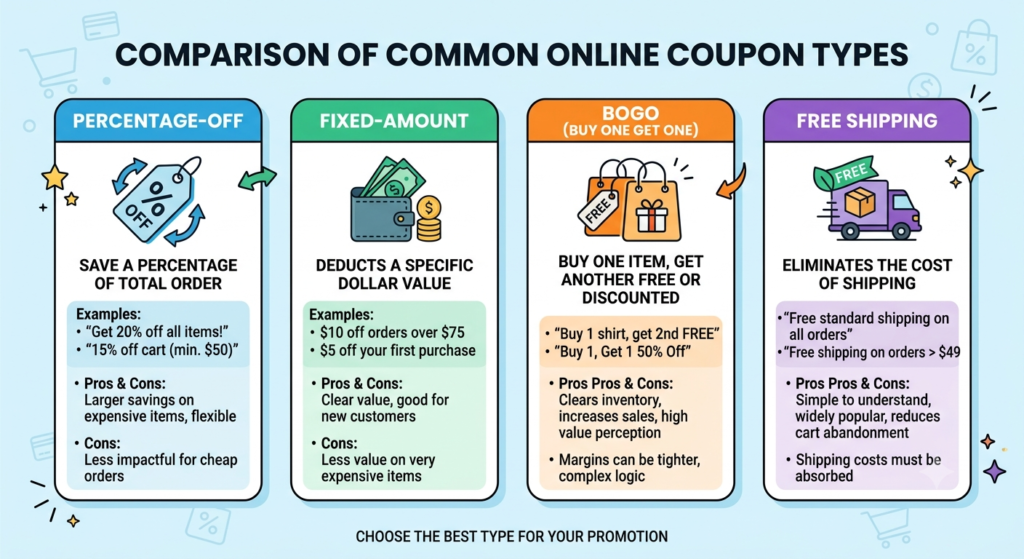
Types of Online Coupons You Will Commonly See

Not all online coupons work the same way. Here are the most common formats you will come across while shopping.

Percentage-off Coupons

These take a set percentage off your total, such as 15% or 25% off. They are consistently one of the most popular coupon formats because the value scales with your purchase, which makes them attractive on larger orders.

Fixed-amount Coupons

This type takes a specific dollar amount off, like $10 off a $50 purchase. These are common for retailers who want to encourage a minimum spend, since the discount only kicks in once you hit a certain threshold.

Buy One, Get One (BOGO) Offers

You buy one item and get a second one free or discounted. This format is especially popular in beauty, apparel, and grocery categories, and it remains one of the more requested coupon types among shoppers.

Free Shipping Codes

Rather than discounting the product itself, these codes waive shipping fees. For many online shoppers, free shipping is just as motivating as a price discount, especially on smaller orders where shipping costs can feel disproportionate.

Cashback and Rebate Offers

Instead of an instant discount, you pay full price and later receive a portion of your money back, either as cash, store credit, or points. Cashback browser extensions and apps have grown quickly in popularity because they work quietly in the background without requiring the shopper to search for a code.

Referral and Loyalty Coupons

These reward you for referring a friend or for being a repeat customer. They tend to build long-term brand loyalty rather than just driving a single purchase.

Automatic or “No Code Needed” Discounts

Some coupons apply themselves the moment you land on a site or add an item to your cart, no code required. Retailers use these when they want a frictionless way to reduce cart abandonment.

First-time Buyer Discounts

These are aimed squarely at new customers as an incentive to complete a first purchase, often shown as a pop-up or offered in exchange for an email signup. Since these codes are typically restricted to accounts that have never ordered before, they usually cannot be reused on future purchases.

Seasonal and Flash Sale Codes

Tied to specific events like Black Friday, back-to-school season, or a brand’s anniversary sale, these codes are usually only valid for a short window. Flash sale coupons in particular tend to create urgency, often lasting just a few hours or a single day, which is meant to push undecided shoppers toward completing a purchase quickly.

How Do Online Coupons Actually Work?

Behind the scenes, an online coupon is really just a rule stored in a retailer’s ecommerce system. Here is the general process from creation to redemption.

1. The Retailer Creates the Offer

A business decides on a promotion, say, 20% off orders over $75, and sets the terms: which products qualify, how long the offer runs, and whether it can be combined with other discounts.

2. A Code or Trigger Is Generated

The system generates a unique code (like SAVE20) or sets up a trigger, such as an automatic discount that appears once a cart reaches a certain value. Some codes are reusable by anyone, while others are single-use and tied to one customer’s email or account.

3. The Coupon Is Distributed

The retailer shares the coupon through email newsletters, social media, affiliate coupon websites, SMS, or in-app notifications. Sometimes a coupon is exclusive to a specific channel, which is why the same brand might have different codes floating around at the same time.

4. The Shopper Applies the Coupon

At checkout, the shopper either enters the code manually, clicks an affiliate link that applies it automatically, or uses a browser extension that scans for valid codes and tests them at checkout.

5. The System Validates It

The retailer’s platform checks whether the code is still active, whether the cart meets the minimum requirements, and whether the customer is eligible. If everything checks out, the discount is applied instantly and the new total is shown before payment.

6. The Order Is Processed

Once payment goes through, the discount is recorded in the retailer’s system. This data helps businesses measure how well a promotion performed, which is part of why coupons are also a useful marketing analytics tool, not just a savings mechanism for shoppers.

What Happens on the Technical Side

Most modern ecommerce platforms, whether it is Shopify, WooCommerce, Magento, or a custom-built system, have a built-in discount engine. When a business creates a coupon, they are essentially writing a set of conditions into that engine. Those conditions might include a specific product category, a minimum order value, a date range, a maximum number of total redemptions, or a limit of one use per customer.

When a shopper enters a code, the platform checks the code against its database in real time. If everything lines up, the price adjustment happens instantly and is reflected in the order summary before payment is even submitted. If something does not match, such as an expired date or an ineligible item in the cart, the system will usually return an error message explaining why the code did not apply.

This is also why the same brand can run several coupons at once. A retailer might have one code active for social media followers, another exclusive to email subscribers, and a third reserved for abandoned cart recovery emails, all running in parallel with different rules attached.

Where to Find Legitimate Online Coupons

With so many coupon codes floating around, quality and reliability vary a lot. According to recent consumer research, shoppers most commonly find coupons through search engines, dedicated coupon and deal websites, and mobile apps, with email offers also playing a major role. Here are the most reliable places to look.

  • Retailer websites and newsletters: Signing up for a brand’s email list often gets you a welcome discount and access to future sales before the general public.
  • Coupon and deal aggregator websites: Sites that collect and verify codes from multiple retailers in one place, often ranked by how recently they were confirmed to work.
  • Browser extensions: Tools that automatically search for and test available codes when you reach checkout, saving you the manual searching. (Important: Choose extensions from reputable developers, as some collect browsing data across all websites you visit. Check permissions carefully before installing).
  • Cashback and rewards apps: Apps that combine coupon codes with cashback offers, letting you stack savings.
  • Retailer apps: Many brands offer app-exclusive discounts to encourage downloads and repeat visits.
  • Social media and influencer partnerships: Brands frequently share time-limited codes through Instagram, TikTok, or partnered creators.
  • Loyalty programs: Points-based programs that convert into coupons or discounts as you shop more with a brand.

A growing share of shoppers, particularly younger consumers, actively search for a discount code before completing almost any online purchase. That habit has pushed retailers to make sure their official codes are easy to find, since an abandoned cart because a shopper could not locate a valid coupon is a lost sale.

A Quick Comparison of Coupon Sources

Source Best For Thing to Watch For
Retailer email list Verified, exclusive offers Can lead to inbox clutter over time
Coupon aggregator sites Comparing codes across brands quickly Not all listed codes are still active
Browser extensions Hands-off, automatic testing of codes Choose well-reviewed, reputable tools only
Cashback apps Stacking savings on top of a coupon Payout minimums and processing time can vary
Retailer’s own app App-exclusive discounts and early access Offers may require an active account

The Real Benefits of Using Online Coupons

For Shoppers

  • Direct savings: The most obvious benefit is a lower total at checkout, which adds up meaningfully over a year of regular shopping.
  • Encouragement to try new brands: Research suggests that a large share of online shoppers are more willing to try a new business when a coupon is offered, lowering the risk of trying something unfamiliar.
  • Better budgeting: Some shoppers use coupons strategically to plan bigger purchases around known sale periods.
  • Convenience: With browser extensions and cashback apps, savings can now happen automatically without much extra effort.

For Businesses

  • Customer acquisition: A first-purchase discount is one of the most common ways to convert a hesitant visitor into a paying customer.
  • Inventory management: Coupons help move excess or seasonal stock without a permanent price cut.
  • Data and insights: Coupon redemption data helps businesses understand which offers, products, and channels perform best.
  • Loyalty building: Exclusive offers for returning customers can strengthen long-term relationships rather than just driving one-time sales.

How Businesses Decide When to Offer a Coupon

From the outside, coupons can look almost random, a surprise 15% off banner one week and nothing the next. In reality, most retailers plan their discount calendar carefully, balancing the desire to drive sales against the risk of training customers to only buy during a sale.

Common Triggers for a Coupon Campaign

  • Slow sales periods: Discounts help maintain revenue during typically quieter shopping months.
  • New product launches: A limited-time discount can encourage early adoption and generate initial reviews.
  • Cart abandonment: Many retailers send a follow-up coupon by email if a shopper leaves items in their cart without completing checkout.
  • Customer win-back campaigns: Businesses often target lapsed customers with a special offer to bring them back.
  • Competitive pressure: If a competitor runs a big sale, other brands in the same category sometimes respond with their own promotion to avoid losing market share.
  • Seasonal calendar events: Major shopping periods such as end-of-year holidays or back-to-school season are reliably some of the busiest times for coupon activity.

Retailers also closely track something called redemption rate, which is simply the percentage of people who received or saw a coupon and actually used it. Industry data suggests the average digital coupon redemption rate sits at approximately 7%, though this varies by format—mobile coupons can reach 10% or higher compared to under 1% for traditional print coupons. This means the vast majority of coupons that are issued are never actually applied. This is one reason retailers keep experimenting with different formats, timing, and personalization rather than relying on a single type of offer.

Are Online Coupons Safe to Use?

For the most part, yes, as long as you get them from legitimate sources. That said, the popularity of online coupons has also attracted scammers, so it is worth knowing what to watch for.

Common Red Flags

  • Coupon codes requiring you to enter sensitive information like a Social Security number or full bank details before you can even see the discount.
  • Deals that seem far too good to be true, such as a 90% discount on a popular brand-name product from an unfamiliar website.
  • Pop-up ads or emails pushing you to “claim your coupon now” with urgent countdown timers on sites you do not recognize.
  • Browser extensions from unverified sources that ask for broad permissions to access all your browsing data.

How to Stay Safe

  • Only download coupon apps and browser extensions from official app stores or verified developer pages.
  • Check that the checkout page uses a secure connection before entering any payment details.
  • Stick to well-known coupon aggregator sites or the retailer’s own official channels when possible.
  • Be cautious with codes shared in random text messages or social media comments, since these are sometimes used for phishing.

This guide is intended for general informational purposes. If you ever suspect a coupon site or offer is fraudulent, it is a good idea to report it and avoid entering any personal or financial information.

Online Coupon Trends to Know in 2026

Couponing has changed a lot in just a few years, and the shift toward digital and mobile-first experiences shows no sign of slowing down. Here are some of the trends shaping the space right now.

Mobile Is the Primary Channel

Smartphones have become the main way shoppers both discover and redeem coupons, with 93.5% of digital coupon users now completing redemptions directly through their mobile devices. Many shoppers even use their phone to apply a code while checking out in a physical store, blending online and in-person shopping in a way that was rare just a few years ago.

Personalization Powered by Data

Retailers increasingly use purchase history and browsing behavior to send more relevant, individualized offers instead of blasting the same discount to everyone. This tends to improve redemption rates because the offer actually matches what the shopper was already interested in.

Automatic and “Codeless” Discounts

More retailers are moving toward discounts that apply automatically at checkout, removing the friction of copying and pasting a code. This trend is partly driven by how many shoppers abandon a cart when a promo code field does not work as expected.

Browser Extensions and Cashback Tools Keep Growing

Tools that automatically search for and apply the best available code have become a normal part of the online shopping experience for a large share of shoppers, particularly in the United States. These tools reduce the time spent manually searching for a working code, which industry data suggests can otherwise take several minutes per purchase.

Gen Z and Younger Shoppers Lead Coupon Usage

Younger consumers are especially active couponers, frequently searching for a discount code before completing almost any purchase. This generation has grown up with digital shopping, so checking for a code feels like a default step rather than an extra one.

QR Codes and Scannable Offers

Especially outside the United States, QR-based discount systems are becoming a common bridge between online promotions and in-store redemption, letting shoppers scan a code with their phone camera to unlock a deal.

Global Growth Outside the United States

Couponing is no longer a mostly American habit. Europe has seen strong adoption of digital coupons, particularly in France, Germany, and the UK, largely driven by mobile shopping. Meanwhile, the Asia Pacific region has become one of the fastest-growing coupon markets globally, with the UK alone seeing 1,133% growth in coupon usage and the European Union experiencing over 200% growth . This surge is fueled by rapid ecommerce and digital payment adoption, with similar steady growth across the Middle East and Africa. This global shift means more international retailers are building coupon strategies into their core marketing plans rather than treating discounts as an occasional add-on.

Tips to Get the Most Out of Online Coupons

  • Sign up before you shop: Many retailers offer a first-time discount just for joining their email list, so it is worth doing before adding items to your cart.
  • Check for stacking rules: Some stores let you combine a coupon with a sale price or loyalty discount, while others do not. Read the fine print before assuming.
  • Compare a few sources: A quick check across a coupon aggregator, a cashback app, and the retailer’s own site can turn up different offers.
  • Watch expiration dates: Time-limited codes are common, so plan bigger purchases around known sale events when possible.
  • Do not let a coupon drive unnecessary spending: Coupons can encourage impulse purchases, so it is worth sticking to what you actually planned to buy.
  • Use a dedicated browser extension carefully: These can save time, but stick to well-reviewed, widely used tools rather than obscure ones with poor reviews.

Frequently Asked Questions

What is the difference between a coupon code and an automatic discount?

A coupon code requires you to type in a specific set of letters or numbers at checkout to unlock the discount. An automatic discount applies itself the moment your cart meets the retailer’s conditions, with no code needed.

Do online coupons expire?

Most do. Retailers typically set an expiration date to create urgency and to control how long a promotion runs. Always check the terms attached to a coupon before planning a purchase around it.

Can I use more than one coupon on the same order?

It depends on the retailer’s policy. Some stores allow stacking multiple discounts, while others only permit one coupon per order. This is usually stated in the coupon’s terms and conditions or the checkout page itself.

Are coupon browser extensions safe to install?

Reputable, well-reviewed extensions from official browser stores are generally considered safe for most users. It is a good idea to check reviews, permissions requested, and the developer’s reputation before installing any extension.

Why didn’t my coupon code work?

Common reasons include an expired code, a cart total below the required minimum, the code being restricted to certain products, or the offer being limited to new customers only. Double-check the coupon’s terms if it fails to apply.

Is it better to use a coupon code or a cashback app?

They serve slightly different purposes. A coupon code lowers your price instantly at checkout, while cashback returns a portion of your spending after the purchase. Many shoppers use both together when a retailer allows it.

Do online coupons actually save money, or do they encourage overspending?

Used intentionally, coupons can genuinely reduce what you pay for things you already planned to buy. However, research suggests coupons can also encourage impulse purchases, so it helps to shop with a clear list in mind rather than letting a discount dictate what you buy.

Final Thoughts

Online coupons have evolved from a simple newspaper clipping into a fast, data-driven part of how people shop and how businesses compete for attention. Whether it is a percentage-off code, an automatic checkout discount, or a cashback app working quietly in the background, the underlying idea has not changed much: a small incentive that benefits both the shopper and the business.

As mobile shopping and personalized offers continue to shape the space in 2026, understanding how these coupons work, and how to use them safely, puts you in a much better position to actually save money rather than just chase deals. A little bit of awareness goes a long way toward making online coupons work for you instead of the other way around.

Why Do Coupon Codes Expire? (And How to Check if a Code Still Works)

You find the perfect item, add it to your cart, and go hunting for a discount code. You paste it in. Nothing happens. Or worse, it works for five seconds and then the checkout page quietly removes it before you hit “place order.”

If that sounds familiar, you are not imagining things and you are definitely not alone. Recent industry research shows that 35% of U.S. online shoppers who used a promo code in the past two months ran into a code that either didn’t work at all or gave a smaller discount than advertised. More than half of shoppers say they’ve paid full price for something, only to stumble across a working code minutes or hours later. It’s one of the more common small frustrations of online shopping, right up there with surprise shipping fees and forgotten passwords.

This guide breaks down exactly why coupon codes expire in the first place, what’s actually happening behind the scenes when a code fails, and how to check whether a code is still valid before you waste time typing it in at checkout.

Why Do Coupon Codes Expire in the First Place?

Coupon codes aren’t set to expire just to annoy you, even though it can feel that way. Retailers and manufacturers build expiration dates into almost every promotion for practical, business-driven reasons. Here’s what’s actually going on.

1. Retailers Need to Create a Sense of Urgency

This is the one most people already suspect, and it’s true. A coupon that never expires doesn’t push anyone to buy today. A coupon that expires Sunday night does. Limited windows are a basic marketing tool, and they work, which is exactly why almost every promo code you see comes with a countdown attached, whether that’s a specific date or a vague “limited time only.”

2. Open-Ended Discounts Are a Financial Liability

From an accounting standpoint, an active coupon is essentially a promise to lose money on a future sale. If a brand issued a code with no end date, that liability would sit on the books indefinitely. Expiration dates let a company close out a promotion cleanly, know exactly what it cost, and move on to planning the next one. This is a big part of why manufacturer coupons in particular are almost always dated, since manufacturers have to reimburse retailers for every coupon redeemed.

3. Codes Are Tied to Specific Inventory or Campaigns

A “buy one, get one” code or a seasonal discount is usually built around a specific batch of stock or a specific marketing push. Once that inventory sells through or the campaign ends, the code stops making sense to honor. Keeping it live would mean applying a discount that was never meant to outlast the promotion it was built for.

4. Pricing and Margins Change

Costs shift. Supplier prices move. A discount that made sense in March might eat into margin too heavily by August. Expiration dates give retailers room to reprice or retire a deal before it becomes unprofitable.

5. Single Use and Limited Redemption Codes

Some codes aren’t really “expired” in the traditional sense. They’re built to work only once, or only for a capped number of total redemptions. Once that cap is hit, the code effectively dies, even if the calendar date on it hasn’t passed yet. This is common with influencer and affiliate codes, which brands often issue with a maximum number of uses baked into the backend.

6. Fraud and Abuse Prevention

Codes that stay active forever are also easier to abuse. Expiration windows, usage caps, and one-per-customer rules all help retailers limit the damage from coupon stacking, bots, and resellers who scrape codes and try to bulk-redeem them.

The Different Types of Coupon Codes (and Why They Expire Differently)

Not all coupon codes are built the same way, and understanding the type of code you’re dealing with can explain a lot about why it stopped working.

Sitewide Promo Codes

These are the broad, marketing-driven codes you see plastered across a homepage banner or a big email blast, like “20% off everything.” They tend to run for a fixed campaign window, often tied to a holiday, product launch, or slow sales period, and they expire the moment that campaign wraps up.

Manufacturer Coupons

These come directly from the brand that makes the product rather than the store selling it. Because the manufacturer has to reimburse the retailer for every redemption, these codes are usually the most strictly enforced. There’s rarely any flexibility once the expiration date passes, since the retailer has no incentive to honor a discount it won’t get reimbursed for.

Influencer and Affiliate Codes

These are the codes you hear read aloud in a podcast ad or see pinned in a creator’s video description. Brands typically allocate a specific budget or a capped number of redemptions to each creator partnership. Once that budget or cap is hit, the code stops working, even though the video or post promoting it stays online indefinitely. This mismatch is one of the biggest reasons people run into dead influencer codes long after they were first shared, and it’s a pattern that has only become more common as creator marketing budgets get spread across more partnerships.

Loyalty and Account-Based Codes

Some codes are generated specifically for your account, based on purchase history, cart abandonment, or loyalty program status. These are single use by design and will always fail for anyone else who tries to use them, regardless of the listed expiration date.

Flash Sale and Clearance Codes

Tied directly to a specific window, often just hours or a couple of days, these codes are meant to move inventory quickly. They tend to have the shortest shelf life of any code type, and they’re the most likely to be gone by the time you find them shared secondhand on social media or a coupon aggregator site.

What Actually Happens When a Coupon Code “Doesn’t Work”

Not every failed code is truly expired. In practice, there are several different reasons a code might get rejected at checkout, and they’re worth telling apart because the fix is different for each one.

  • The code has genuinely expired. The promotion window closed and the system now rejects it automatically.
  • It’s already been redeemed the maximum number of times. Either by you, or the code hit its overall usage cap.
  • It’s region or currency locked. A code built for the UK site won’t always work on the US version of the same store.
  • It requires a minimum order value you haven’t hit yet. Add another item and it may suddenly apply.
  • It excludes certain categories or already-discounted items. Sale items, gift cards, and clearance sections are commonly excluded.
  • It’s for new customers only. Returning shoppers often get quietly blocked from “welcome” style codes.
  • It’s a session or cart timing issue. Some shoppers report a code that appears to apply, then disappears right before the order finalizes. This is usually a backend validation check running a second time at final checkout.

According to recent survey data, hidden restrictions like these hit younger shoppers hardest, with 18 to 24 year olds experiencing them at notably higher rates than shoppers over 65. That’s likely a reflection of who is doing the most active code hunting online in the first place.

The Coupon Code Ecosystem Has Changed a Lot Recently

Coupon codes used to be something you stumbled across in an email newsletter or a magazine insert. That’s not really how most people find them anymore.

The current picture looks something like this:

  • The large majority of American online shoppers now actively search for a promo code before completing a purchase, rather than checking out at the listed price.
  • Automatic coupon browser extensions have become mainstream. Roughly half of U.S. consumers now have some kind of tool running in the background of their browser that automatically tests codes at checkout, which is more people than rely on retailer emails for deals.
  • Social media has become a major discovery channel, and for younger shoppers it’s the primary one, ahead of email, search, and dedicated coupon sites combined.
  • Influencer promo codes, the kind you hear in a podcast ad or see in a creator’s video caption, have become extremely common, but they’re also becoming less reliable. Brands frequently cap redemptions or quietly retire creator codes once a campaign budget runs out, even while the video promoting the code stays live indefinitely.

That last point matters more than people realize. A video or blog post promoting a code doesn’t get deleted just because the code expired. That’s part of why the internet is full of outdated codes long after they’ve stopped working.

There’s also a generational split worth noting. Older shoppers tend to still favor email newsletters as their main way of discovering deals, while younger shoppers have shifted almost entirely toward social platforms and short-form video. That shift changes how quickly a code spreads, and also how quickly it goes stale. A code shared in a newsletter typically reaches its audience within days and the email eventually stops circulating. A code shared in a viral video or post can keep getting discovered by new viewers for months, long after the original promotion ended, which is part of why social media has become such a common source of expired codes.

Why the Internet Is Full of Expired Codes

If you’ve ever wondered why a coupon aggregator site shows twenty codes and only one or two actually work, there’s a straightforward explanation. Some coupon sites benefit from listing a large volume of codes, expired or not, because it signals to search engines and to visitors that the site is active and comprehensive. A page with ten expired codes and one working one can still drive more traffic than a page with just the single valid code, simply because it ranks for more search terms.

It’s not necessarily malicious. It’s often just outdated content that never got cleaned up, sitting on a page that Google still ranks because the domain has authority. Either way, the practical result is the same for you as a shopper: you can’t assume a code works just because it’s listed on page one of a search result.

How to Check if a Coupon Code Still Works

Before you copy and paste a random code and hope for the best, a few quick habits can save you a lot of wasted clicks.

1. Check the Listed Expiration Date First

This sounds obvious, but a surprising number of failed attempts come down to simply not noticing the code expired days or weeks ago. Reputable coupon sites list an expiration or “last verified” date next to each code. If that date has passed, or if there’s no date listed at all, treat the code with suspicion.

2. Look for a “Last Verified” or “Works” Confirmation

Some coupon platforms now rely on real shoppers testing codes in real time, rather than just scraping and listing every code they can find. If a site shows recent user confirmations, success rates, or a “verified today” style tag, that’s a much stronger signal than a static list with no freshness indicators.

3. Read the Fine Print, Not Just the Discount Percentage

Before assuming a code is broken, check for:

  • A minimum spend requirement
  • Category exclusions (sale items, gift cards, certain brands)
  • New customer only restrictions
  • Regional or currency limitations
  • One use per account or per household limits

A code that “doesn’t work” often just needs one more item in the cart, or applies to a different section of the site than the one you’re shopping in.

4. Try a Coupon Browser Extension

Rather than manually testing codes one at a time, browser extensions can test an entire database of codes for a retailer automatically at checkout and apply whichever one gives you the best discount. This has become one of the most common ways shoppers find working codes in 2026, and it removes most of the trial and error. Popular tools in this category test dozens of codes in the background and only apply one if it actually reduces your total.

5. Check Multiple Sources Before Giving Up

No single coupon site has every working code for every retailer. Cross-checking two or three sources, or letting a browser extension do that cross-checking for you, meaningfully improves your odds compared to relying on one listing.

6. Time Your Shopping Around Seasonal Patterns

Coupon reliability isn’t flat across the year. Industry tracking shows that promo code success rates dip noticeably in late winter, particularly February and March, as holiday promotions wind down and new spring campaigns haven’t fully launched yet. Reliability tends to climb through the summer months and peaks in the fall. If you have flexibility on timing, shopping outside the post-holiday lull can improve your odds of finding a code that actually works.

7. Contact Customer Service if the Code Should Still Be Valid

If you have a code from a source you trust, like a direct email from the retailer, and it’s still failing before the stated expiration date, it’s reasonable to reach out to customer support. Retailers will sometimes honor a code manually or issue a comparable discount if there was a technical glitch on their end.

What to Do When a Coupon Code Has Actually Expired

Finding out a code is genuinely dead doesn’t have to mean paying full price. A few options are worth trying first.

  • Ask politely. Store coupons, as opposed to manufacturer coupons, are sometimes accepted by staff or customer service reps shortly after expiration, particularly if you ask directly rather than assuming it’s a lost cause.
  • Sign up for the newsletter. Many retailers issue a fresh welcome discount the moment you subscribe, which can replace an expired code entirely.
  • Check for a sitewide sale instead. Sometimes a store swaps an expired code for a broader sale that offers a similar or better discount without needing a code at all.
  • Wait a few days if you’re not in a rush. New codes are issued constantly, and a similar or better discount often appears within a short window, especially around common promotional periods.
  • Abandon the cart, but don’t delete the browser tab. Retailers frequently email an incentive to shoppers who leave items sitting in a cart, sometimes including a fresh discount code to bring you back.


A Word of Caution: Not Every “Coupon” Is Legitimate

As coupon hunting has become more automated and more social, it has also attracted a small but real amount of scam activity. A few things are worth watching for:

  • Codes that ask for unnecessary personal information. A legitimate coupon code should apply at checkout without requiring you to enter sensitive details like a full Social Security number or banking login on a third-party page.
  • Browser extensions with vague or excessive permissions. Before installing any coupon or cashback extension, it’s worth checking what data it collects and how it’s used. Reputable extensions are generally upfront about this in their privacy policy and Chrome Web Store or Firefox Add-ons listing.
  • Too-good-to-be-true discounts shared via unsolicited text or direct message. Scammers sometimes use the promise of a huge discount code as bait to get you to click a phishing link. If a “coupon” arrives from an unexpected source and pushes you to act immediately, treat it with extra skepticism.
  • Sites that require payment to “unlock” a coupon code. Legitimate coupon codes are free. Any site charging a fee to reveal a code is a red flag.

None of this means coupon hunting is risky by default, most of it is completely routine and safe. It just helps to apply the same basic caution you would with any other online offer.

A Quick Reference: Common Reasons Codes Fail

Reason Code Fails What It Usually Means What You Can Try
Past expiration date Promotion window has closed Search for a newer, active code
Usage limit reached Code hit its total redemption cap Look for an alternate code from the same brand
Minimum spend not met Cart total is below the required threshold Add an item or check for a lower-threshold code
Excluded items in cart Sale or clearance items often don’t qualify Check the code’s terms for exclusions
New customer only Returning shoppers are blocked Check newsletter signup for a returning customer offer
Region or currency mismatch Code built for a different country’s storefront Confirm you’re on the correct regional site

Are Coupon Codes Still Worth the Effort?

Given how often codes fail, it’s fair to wonder whether hunting for one is worth the time. The data suggests most shoppers still think so. A majority of U.S. online shoppers report using a coupon code in the last two months, and more than half say they’ve switched to a different retailer specifically because a competitor had a working code available. Coupon use hasn’t slowed down, it’s just become more automated, with extensions and verified code databases doing a lot of the legwork that used to require manually searching multiple sites.

The most common reaction to a failed code isn’t giving up either. Most shoppers who hit a dead code simply go ahead and buy at full price anyway, while a smaller share abandon the purchase entirely. Either way, a few extra minutes spent checking a code’s terms and freshness before checkout can be the difference between one of those outcomes and actually getting the discount you were hoping for.

Frequently Asked Questions

Why do coupon codes expire so quickly?

Most codes are tied to a specific marketing campaign, budget, or inventory window. Once that campaign ends or the allocated discount budget runs out, retailers typically deactivate the code rather than let it run indefinitely, since an open-ended discount represents an ongoing cost.

Can a coupon code work after its expiration date?

Occasionally, yes. Some systems don’t deactivate a code until the very end of the expiration day, so a code listed as expiring “today” may still work until midnight local time. In rare cases, a retailer’s system may also have a delay in updating, though this isn’t something to count on.

Why do coupon sites list so many expired codes?

Coupon aggregator sites often keep expired codes listed because they still drive search traffic, and cleaning out old listings takes ongoing effort. Some sites also list unverified codes scraped from other sources without confirming whether they’re currently active, which is part of why cross-checking multiple sources or using a verified-code site tends to work better.

Is it illegal to use an expired coupon code?

No, trying an expired code isn’t illegal. It simply won’t be accepted by the retailer’s system. The only real risk is wasted time, not any legal consequence.

Do browser extensions that auto-apply coupons actually work?

Many shoppers find them genuinely useful, since these tools test a database of codes automatically at checkout rather than requiring manual entry. Results vary by retailer and by which extension you use, and it’s worth reading an extension’s privacy practices before installing it, since it will have visibility into your checkout activity.

Why did my coupon code apply and then disappear at checkout?

This is usually caused by a second validation check that runs right before an order finalizes, which can catch issues like a code hitting its usage cap in the seconds between when you entered it and when you completed the purchase. It can also happen if your cart contents changed slightly, such as an item going out of stock.

Are manufacturer coupons and store coupons treated differently when it comes to expiration?

Yes. Manufacturer coupons are almost always strictly enforced because the manufacturer reimburses the retailer for each redemption, leaving little flexibility. Store coupons, since they’re issued and controlled entirely by the retailer, are sometimes honored slightly past their expiration date at a staff member’s discretion.

The Bottom Line

Coupon codes expire because businesses need to control costs, manage inventory, and create a reason for you to buy now rather than later. That’s not going to change. What has changed is how much easier it’s become to check whether a code is actually still valid before you rely on it, whether that’s through a browser extension that tests codes automatically, a coupon site that shows real-time verification, or simply reading the fine print before assuming a code is broken.

A little bit of checking goes a long way. The next time a code fails at checkout, it’s worth pausing before you either give up or pay full price, since there’s a decent chance the fix is as simple as adding one more item to your cart or finding a code that was verified more recently.

The Smart Shopper’s Guide to Finding Verified Deals in 2026

Online shopping in 2026 looks nothing like it did even three or four years ago. Prices update by the hour, “sale” badges show up on products that were never actually marked down, and AI-generated reviews have made it harder than ever to tell a genuine bargain from a marketing trick. At the same time, shoppers now have more tools than ever to fight back, from price history trackers to browser extensions that test coupon codes automatically at checkout.

This guide walks through how to actually verify a deal before you buy, which tools are worth installing, how to read reviews with a skeptical eye, and how to time your purchases around the shopping events that matter most this year. Whether you are trying to save on a laptop, furnish a first apartment, or just stop overpaying for groceries, the goal here is the same: help you shop with confidence instead of guesswork.

Table of Contents


Quick Reference: Deal Verification Tools at a Glance

Before we get into the details, here is a snapshot comparison of some of the most commonly used deal verification and money saving tools available in 2026. This should help you decide which ones are worth adding to your browser right away.

Tool Best For Store Coverage Cost Key Feature
Capital One Shopping Price comparison across retailers Amazon, Walmart, Best Buy, and hundreds more Free, no account needed Compares prices across competing sites including shipping cost, plus a price history chart
Rakuten Cashback on purchases Thousands of partner retailers Free Cashback percentage credited after purchase, paid out via PayPal or check
Keepa Amazon price history Amazon only Free, with a paid tier for extra alerts Long term price charts so you can see if a “deal” is actually a low price
CamelCamelCamel Amazon price drop alerts Amazon only Free Email alerts when a tracked item hits your target price
Honey (PayPal) Auto applying coupon codes Tens of thousands of stores Free Tests codes at checkout automatically, though it is worth reading the note below on recent trust concerns
CouponCabin Sidekick Combined coupons and cashback Thousands of stores Free Applies coupons and activates cashback in one step

A quick note on Honey: independent reporting in late 2025 raised concerns about how the extension handled affiliate links, and Rakuten Advertising removed Honey from its affiliate network in January 2026. The extension still works for finding coupon codes, but it is worth treating it as one option among several rather than your default, and disabling it when you specifically want a cashback portal like Rakuten or Capital One Shopping to get credit for your purchase.

Why Verified Deals Matter More Than Ever

Retailers know that shoppers are drawn to red banners, countdown timers, and phrases like “limited time only.” That is not new. What has changed is the sheer volume of pricing data being thrown at consumers every day, combined with dynamic pricing systems that can change a product’s price several times within a single day depending on demand, inventory, and even the device you are browsing from.

On top of that, fake or misleading reviews remain a persistent problem. The Federal Trade Commission’s Consumer Review Rule, which took effect in October 2024, made it illegal for businesses to buy, sell, or post fake reviews, or to offer incentives in exchange for a specific star rating. In late 2025 and into 2026, the FTC sent warning letters to multiple companies over suspected violations, a sign that enforcement is an ongoing priority rather than a one time announcement. That is good news for consumers, but it does not mean every fake review has disappeared from the internet. Shoppers still need to do some of their own verification.

The bottom line is that a discount is only meaningful if you know what the item actually costs elsewhere, or what it has cost historically. That is where deal verification tools and a bit of shopping discipline come in.

How to Spot a Fake Discount

Inflated “original” prices are one of the oldest tricks in retail. A product gets listed at an artificially high price for a short window, then marked down to what was really the intended selling price all along, creating the illusion of a big discount. Here is how to protect yourself.

Check the price history before you trust the percentage off

A tool like Keepa or CamelCamelCamel can show you a chart of what an item has actually sold for over the past several months. If a “50 percent off” item has been at that same price for most of the year, it is not really a deal, it is just the normal price with a sticker on it.

Compare across at least two or three retailers

Price comparison extensions like Capital One Shopping can automatically show you if the same product is cheaper somewhere else, factoring in shipping costs, which many people forget to account for when comparing totals.

Watch for urgency language that never actually expires

If a countdown timer resets every time you revisit a page, or a banner claims “only 3 left in stock” on every visit regardless of how many times you have checked, that is a manufactured sense of scarcity rather than real inventory data.

Look closely at coupon stacking restrictions

Some retailers advertise a coupon code that technically works, but only on full priced items, meaning it will not actually apply during a sale. Reading the fine print, or letting a browser extension test the code for you, saves you from assuming a discount that does not exist.


The Best Apps and Browser Extensions for Verified Deals

There is no need to manually hunt for coupon codes anymore. A handful of well established tools can do the legwork for you. Here is a closer look at the categories worth knowing.

Price comparison tools

Capital One Shopping remains one of the most useful free tools for this in 2026. You do not need a Capital One card or account to use it. When you land on a product page at a supported retailer, it scans competing sites and flags whether the same item is available for less elsewhere, including shipping costs in the comparison. It also includes its own price history chart, which is handy for confirming whether a sale price is genuinely lower than usual.

Cashback platforms

Rakuten remains a popular option, offering cashback at thousands of partner stores that gets paid out through PayPal or a mailed check. CouponCabin’s Sidekick extension takes a similar approach but combines the cashback step with automatic coupon testing, which can be convenient if you would rather manage one tool instead of two.

Coupon code testers

These extensions scan a database of codes and test them automatically at checkout. Success rates vary quite a bit by retailer and by season. Independent testing in 2026 found that coupon extensions generally find a working code somewhere between 30 and 60 percent of the time during normal shopping periods, with average savings in the 10 to 15 percent range when a code actually works. During major sales events like Black Friday, success rates tend to drop, since many retailers restrict stacking a coupon on top of an already discounted sale price.

Amazon specific price trackers

Keepa and CamelCamelCamel both specialize in Amazon price history, letting you set alerts for a target price and see charts going back months or even years. This is particularly useful during major Amazon sales events, when it is easy to assume a listed discount is bigger than it actually is.

Mobile apps versus browser extensions

Most of the tools mentioned above also offer mobile apps, which matter more than they used to now that a large share of online shopping happens on phones. Mobile versions typically offer push notifications for price drops, barcode scanning for in store price comparisons, and wishlist syncing across devices. If you do most of your browsing on a phone rather than a desktop computer, it is worth checking whether your preferred deal verification tool has a well reviewed app, since browser extensions generally only work on desktop browsers or mobile browsers that support extensions, which not all of them do.

A word on permissions and privacy

Before installing any shopping extension, take a moment to check the developer’s reputation, read recent reviews in the browser’s extension store, and set the extension’s site access to “on click” rather than granting it full access to every page you visit. This limits what the extension can read and change while you browse, without disabling its core functionality.

Price Tracking: Is That “Sale” Actually a Good Price

Price tracking is arguably the single most reliable way to verify a deal, because it removes guesswork and replaces it with actual historical data. Here is a simple approach:

  • Before buying anything over roughly fifty dollars, check its price history if a tracker is available for that retailer.
  • Look for the lowest price the item has hit in the past three to six months, not just the past few weeks.
  • If the current “sale” price is close to or above that recent low, it may be worth waiting for the next markdown cycle.
  • Set a price drop alert for anything you are not in a rush to buy, so the tool notifies you instead of you having to check manually.

Editorial teams that fact check seasonal sales events, including major retail holidays, commonly cross reference deals against price trackers to confirm an item is actually at or near its lowest verified price before recommending it, which is a good habit for individual shoppers to borrow as well.

Reading Reviews You Can Actually Trust

Star ratings alone do not tell the whole story. Some fake reviews are glowing five star endorsements meant to boost a product, while others are fake negative reviews planted by a competitor. A few habits can help you filter out the noise.

Read reviews across multiple platforms

Do not rely solely on the reviews shown directly on a retailer’s own product page. Checking independent review sites, search engines, and even social media mentions gives you a broader, less curated picture.

Pay attention to review patterns, not just star counts

A sudden spike in five star reviews within a short window, especially if many of them use similar phrasing, can be a sign of coordinated or incentivized reviews rather than organic feedback.

Know your rights around fake reviews

Under the FTC’s Consumer Review Rule, it is illegal for a business to buy or sell fake reviews, offer compensation in exchange for a specific star rating, or have employees post reviews without disclosing their connection to the company. If you suspect a review is fake or bought, you can report it directly through the retailer’s platform or to the FTC.

Search the product name alongside words like “complaint” or “review”

This simple search habit, recommended by consumer protection resources, often surfaces independent forum discussions or news coverage that would not show up in a standard product search.

Coupon Stacking and Cashback Strategies

Stacking, meaning combining more than one discount method on a single purchase, can meaningfully increase your savings if done correctly. Here is a practical order of operations that tends to work well.

  1. Start with a price comparison tool to confirm you are on the retailer offering the lowest base price.
  2. Apply a coupon code, either manually or through an extension, before entering payment information.
  3. Activate a cashback portal like Rakuten or CouponCabin before completing checkout, since cashback typically will not apply retroactively.
  4. Use a rewards credit card that offers bonus points or cashback in that specific spending category, if you have one and can pay it off in full.
  5. Check for a retailer specific loyalty or email signup discount, which is often an extra 10 to 15 percent that can be combined with the steps above.

One important caveat: some coupon browser extensions can conflict with cashback tracking if both try to redirect your browser at checkout. If a cashback portal does not seem to be tracking correctly, try disabling other shopping extensions temporarily and completing the purchase through the cashback link directly.


Timing Your Purchases Around Major Sales Events

Timing matters almost as much as the tools you use. Retailers concentrate their biggest verified discounts around a handful of recurring events each year.

Amazon Prime Day

In 2026, Amazon moved Prime Day earlier than usual, running the event June 23 through June 26, a four day window compared to the shorter two day events of earlier years. The shift to June, rather than the more traditional July timing, was reportedly done in part to avoid overlapping with other major events on the summer calendar. Amazon also runs a second major event later in the year, often called Prime Big Deal Days, typically in early to mid October, though exact dates are usually confirmed closer to the event.

Back to school season

Late July through early September tends to bring discounts on electronics, dorm and home essentials, and clothing, as retailers compete for back to school and college shoppers.

Black Friday and Cyber Monday

These remain the biggest shopping events of the fourth quarter. Because so many shoppers are watching prices closely during this window, retailers are generally more cautious about inflating “original” prices, but it is still worth checking price history, since not every discount advertised during this period is actually the lowest price of the year.

End of season clearance windows

Apparel, patio furniture, and seasonal goods often see their deepest discounts just after the relevant season ends, rather than during it, since retailers are trying to clear inventory to make room for new stock.

Building a Habit Instead of a One Time Effort

One thing seasoned deal hunters tend to agree on is that verification works best as a habit, not a one off task you only do for big purchases. Once a price tracker or comparison extension is installed, checking it takes a few seconds, and that small bit of friction is often enough to stop an impulse buy that was not actually a good deal. Over the course of a year, those few seconds add up to real savings, especially on categories where prices fluctuate constantly, like electronics, home appliances, and travel.

It also helps to separate wants from needs when deciding whether to buy immediately or wait for a price drop alert. If you genuinely need an item right away, a modest discount today may still be worth taking. If it is something you can wait on, letting a price tracker do the watching for you removes the temptation to check obsessively or talk yourself into a purchase before the price actually drops.

Keep a simple record of what you paid

A lot of shoppers assume they will remember whether a price was actually a good one, but memory is not reliable here, especially with dynamic pricing changing totals from one day to the next. Keeping a simple note, spreadsheet, or even a folder of screenshots for larger purchases makes it easier to spot patterns over time, such as which retailers tend to run genuine sales versus which ones mostly rely on inflated “original” prices.

Do not let sunk cost thinking drive a purchase

If you have spent twenty minutes comparing prices and reading reviews, there can be a temptation to buy simply because of the time already invested, even if the research turned up lukewarm results. It is worth remembering that the goal of verification is to make a better decision, not to justify one you have already talked yourself into.

Red Flags of Online Shopping Scams

Not every “deal” that looks too good to be true is a scam, but a meaningful number are. Consumer protection resources point to several recurring warning signs.

  • A seller insists on payment only through gift cards, wire transfers, cryptocurrency, or a peer to peer payment app rather than a credit card. Legitimate retailers do not require this.
  • The website lacks basic contact information, a return policy, or clear shipping timelines.
  • Prices are dramatically lower than every other retailer for a well known, in demand product, particularly around major sales events when scammers often set up lookalike sites.
  • You are pressured to act immediately, with little ability to research the seller or product first.
  • The checkout page does not use encryption, though keep in mind that having “https” in the URL alone does not guarantee a site is legitimate, since scammers can encrypt fraudulent sites too.

Paying with a credit card rather than a debit card or other payment method generally gives you stronger dispute rights if something goes wrong, since federal law lets you dispute certain unauthorized or incorrect charges within 60 days of your first billing statement showing the error.

A Simple Verified-Deal Shopping Checklist

Here is a condensed routine you can run through before making any non essential purchase over a modest dollar amount.

  • Check the price history using a tracker if one is available for that retailer.
  • Compare the price against at least one other retailer, factoring in shipping.
  • Read reviews across more than one platform, not just the retailer’s own page.
  • Search the product or seller name alongside “complaint” or “scam” to check for red flags.
  • Apply a coupon code and activate any cashback portal before you check out.
  • Pay with a credit card when possible for stronger dispute protection.
  • Confirm the return policy before buying, especially for sale or clearance items, since return windows and rules can differ from full priced purchases.

Frequently Asked Questions

How do I know if an online discount is real?

The most reliable way is to check a price history tool, such as Keepa or CamelCamelCamel for Amazon products, or a price comparison extension for other retailers. If the current “sale” price matches or is close to the item’s typical price over the past few months, the discount may be smaller than advertised.

Are coupon browser extensions safe to use?

Reputable extensions from established companies with transparent privacy policies are generally considered safe, though it is wise to review what permissions you are granting, set site access to “on click” when possible, and avoid extensions with vague ownership or minimal reviews.

Why did some coupon codes stop working during major sales like Black Friday?

Many retailers restrict coupon stacking during peak sales periods, meaning a code that normally works on a full priced item may not apply once a sale discount is already active. This is a common reason coupon extensions show lower success rates during major shopping events.

Can I trust product reviews on retailer websites?

Reviews can still be a useful signal, but they are not infallible. The FTC’s Consumer Review Rule prohibits businesses from buying or posting fake reviews, but enforcement takes time, so it is still worth reading reviews across multiple sources and watching for unusual patterns, such as a sudden burst of very similar five star reviews.

What is the safest way to pay for a deal I found online from an unfamiliar seller?

Credit cards generally offer stronger fraud and dispute protections than debit cards, gift cards, wire transfers, or payment apps. If a seller insists on one of those non credit card payment methods, treat that as a warning sign rather than a normal request.

When are the best times of year to find verified deals?

Major recurring events like Amazon Prime Day, Black Friday, Cyber Monday, back to school season, and end of season clearance windows tend to bring the deepest and most widely verified discounts. That said, it is still worth checking price history even during these events, since not every advertised discount is at its actual lowest point.

Does a lower price always mean a better deal?

Not necessarily. Factor in shipping costs, return policies, and product quality alongside price. An item that is a few dollars cheaper but has a restrictive return window or comes from an unfamiliar seller is not automatically the better choice.

Final Thoughts

Finding a genuinely good deal in 2026 is less about luck and more about having the right habits and tools in place. Price history trackers take the guesswork out of whether a sale is real, comparison tools make sure you are not overpaying at one retailer when another has it cheaper, and a bit of skepticism toward reviews and urgency tactics can save you from a purchase you will regret. None of this requires becoming an expert bargain hunter overnight. Start with one or two tools from this guide, build the habit of checking price history before you buy, and the rest will start to feel automatic.

This article is provided for general informational purposes and reflects publicly available information as of June 2026. Prices, promotions, extension features, and retailer policies change frequently, so always confirm current details directly with the retailer or tool provider before making a purchase decision.

What is the biggest sales day in the US?

The biggest sales day in the US depends on how you measure it. Cyber Monday is the biggest single-day online shopping event, while Black Friday remains the biggest in-store shopping day. In 2025, Cyber Monday generated record online sales, making it the top digital shopping day in America.

In this guide, we are going to walk through every major shopping day in the American retail calendar, look at the real numbers, and help you understand why certain days explode with spending while others quietly fade. Whether you are a shopper trying to time your purchases or a business owner planning your promotions, this breakdown is for you.


The Clear Winner: Cyber Monday Is the Biggest Single Sales Day in the US

If we are talking purely about online retail sales on a single calendar day, Cyber Monday wins — and it is not particularly close right now. In 2025, US consumers spent $14.25 billion online in a single day, making it the biggest online shopping day in American history, according to Adobe Analytics.

To put that into perspective, Americans were spending roughly $16 million every single minute during peak hours between 8 PM and 10 PM on Cyber Monday 2025. That is not a typo. Sixteen million dollars per minute.

Cyber Monday has held the top spot for online spending for most of the past decade, and it keeps breaking its own record year after year. In 2024, it brought in $13.3 billion. Before that, each year reliably topped the one before it. The trajectory has been steep and consistent.

But here is the thing most people miss: Cyber Monday was not always about online shopping domination. It started almost by accident.

How Cyber Monday Got Its Name

The National Retail Federation coined the term Cyber Monday in 2005 after noticing a curious pattern. In the early 2000s, home internet connections were slow. Most people still relied on the faster internet speeds at their offices. So when they came back to work on the Monday after Thanksgiving weekend, they kept shopping online using their faster workplace connections. Year after year, without anyone planning it, that particular Monday produced a massive spike in online retail activity.

The NRF decided to put a name to it, and the rest is retail history. Within a few years, what started as an observation turned into a self-fulfilling retail juggernaut. Brands began offering exclusive Cyber Monday deals. Shoppers started circling the date on their calendars. E-commerce platforms prepared for the traffic surge months in advance.

Today, the original reason for the spike — slow home internet — no longer exists. Yet the shopping holiday has taken on a life of its own, driven by consumer expectations, retailer promotions, and deeply ingrained habit.

Online shopping on Cyber Monday the biggest sales day in America

Black Friday: The Cultural Icon That Still Packs a Punch

Ask most Americans to name the biggest shopping day of the year and they will say Black Friday without blinking. It has that kind of cultural weight. The midnight lines, the frantic race for doorbusters, the stories of shopping cart skirmishes that somehow made the evening news — Black Friday is embedded in the American consciousness in a way Cyber Monday never quite matched.

And to be fair, Black Friday is absolutely enormous. In 2025, US consumers spent $11.8 billion online on Black Friday alone, which was the first time in history that Black Friday online sales crossed the $11 billion mark. That figure represented 9.1% growth compared to the previous year. It is also the fourth consecutive year Black Friday set a new online spending record.

On top of the online numbers, 81.7 million Americans showed up to physical stores on Black Friday 2025 — the highest in-person turnout since before the pandemic. Department store foot traffic climbed nearly 8% compared to 2024. People are still showing up, still filling carts, still chasing a deal they can touch before they buy it.

Where Did the Name Black Friday Actually Come From?

The history here is a little murky, but the most credible origin story traces back to Philadelphia in the 1960s. Police officers in the city started using the term “Black Friday” to describe the chaos that descended on the day after Thanksgiving. The combination of post-holiday crowds, early Christmas shoppers, and a big Army-Navy football game that weekend turned the streets into gridlock and the stores into absolute mayhem.

The accounting theory — that retailers moved from being in the red to being in the black on that day — came later and was likely retrofitted onto an already popular name. Retailers appreciated the profit framing and ran with it, which helped cement Black Friday as a positive cultural event rather than just a descriptor for urban chaos.

Black Friday vs. Cyber Monday: What Changed?

For most of the 2000s and early 2010s, Black Friday was king. It was the unquestioned biggest day in American retail, full stop. But e-commerce growth steadily shifted the balance. By the mid-2010s, Cyber Monday had overtaken Black Friday in raw online spending. Black Friday held onto the in-store crown, but its overall dominance faded.

Then something unexpected happened: Black Friday started eating Cyber Monday’s lunch online too. In 2019, for the first time, Black Friday topped Cyber Monday as the busiest day for online shoppers by sheer traffic volume, according to NRF data. More people were browsing online deals on Black Friday than on Cyber Monday, even if they were spending slightly less per transaction.

Retail experts now describe what was once a clean two-day distinction as a completely blurred five-to-seven day spending window. As one expert put it, “Years ago, Black Friday was the in-store shopping day, and Cyber Monday was the online shopping day. That separation no longer exists — they are simply two peaks in a longer sale period.”

Some analysts have started calling it “Black November,” acknowledging that major retailers now run Black Friday promotions throughout the entire month leading up to Thanksgiving.

Black Friday in-store shopping crowds at a US retail mall

Cyber Week: The Five Days That Move More Money Than Almost Anything Else

Cyber Week — the five-day stretch from Thanksgiving Day through Cyber Monday — has become the dominant framework for understanding peak holiday retail in America. When you zoom out from individual days to this window as a whole, the numbers are staggering.

In 2025, Cyber Week generated $44.2 billion in US online sales, up 7.7% year over year. That is nearly half a trillion dollars over just five days, driven by a combination of Thanksgiving deals, Black Friday, the following weekend, and Cyber Monday.

Breaking it down by individual day within that window:

Thanksgiving Day

Thanksgiving itself has quietly grown into one of the biggest online shopping days of the year. In 2025, Americans spent $6.4 billion online on Thanksgiving Day. Many people now shop on their phones between bites of turkey, and retailers have leaned into this by launching deals before Black Friday even begins. The result is a Thanksgiving spending number that would have seemed impossible just ten years ago.

Black Friday

As covered above, $11.8 billion online plus tens of millions of in-store shoppers. Still an absolute powerhouse.

The Weekend (Saturday and Sunday)

The two days between Black Friday and Cyber Monday together generated another $11.8 billion online in 2025. Retailers keep deals alive across the weekend to maintain momentum, and shoppers who missed out on Friday keep browsing.

Cyber Monday

The grand finale at $14.25 billion online, closing out the week at peak velocity.

Collectively, Cyber Week is simply the biggest stretch of retail activity in the entire American calendar, and it keeps growing.

Amazon Prime Day: A Summer Sales Giant

For a long time, Cyber Week and Black Friday had a monopoly on blockbuster retail moments. Then Amazon decided in 2015 to invent their own holiday.

Prime Day started as a somewhat modest birthday party for Amazon — a one-day sale for Prime members celebrating the company’s anniversary. It was a smart idea that turned out to be a genuinely massive one. Over the next decade, Prime Day grew into one of the most significant retail events in US history.

In 2025, Amazon expanded Prime Day to four days for the first time, running from July 8 to July 11. The results were extraordinary. US consumers spent $24.1 billion online across all retailers during those four days, a 30.3% increase over 2024. That total is roughly the equivalent of two Black Fridays combined.

More than 307 million items were purchased during the 2025 Prime Day event. Around 88% of all Amazon Prime members shopped during those four days, which translated to roughly 152 million shoppers. At peak moments, orders were coming in at over 100,000 per minute worldwide.

If you are doing the math, yes: in terms of total dollars spent across a multi-day window, Prime Day 2025 out-earned Cyber Week 2025. However, it is important to note the comparison is complicated — Prime Day ran for four days versus Cyber Week’s five, and the Cyber Week figure represents US online spending only while Prime Day figures include some broader retailer activity.

What is clear is that Prime Day has fundamentally changed the American retail calendar. It turned July into a major shopping month, pulled spending out of a traditionally slow summer retail period, and forced competing retailers — Target, Walmart, Best Buy, and hundreds of others — to launch their own parallel summer sales events during the same window. Amazon essentially created a second Cyber Week in the middle of summer.

Amazon Prime Day packages representing one of the biggest sales days in US history

Super Saturday: The Last-Minute Shoppers’ Day

Every year, on the Saturday immediately before Christmas, a quiet but remarkably large retail event takes place across America. It goes by the name Super Saturday, sometimes called Panic Saturday, and it consistently generates around $15 billion in total retail sales.

Super Saturday is driven by a very human reality: a huge portion of the American population procrastinates on Christmas shopping. Studies have shown that a significant share of consumers have not finished — or in some cases even started — their holiday shopping by the time this day rolls around. Faced with the clock ticking toward Christmas morning, they flood into stores and urgently complete their lists.

Unlike Cyber Monday or Black Friday, Super Saturday leans heavily on physical retail. When Super Saturday falls two weeks before Christmas, online shipping windows are still open. But when it falls just one week before, shoppers who need gifts in hand by December 25 are essentially forced into stores. That dynamic makes Super Saturday one of the most important in-store shopping days of the entire year, and retailers respond accordingly with extended hours, additional staffing, and aggressive last-minute promotions.

The day also creates an interesting phenomenon for impulse buying. People coming in to grab one specific item tend to leave with several. The urgency of the moment, combined with holiday promotions and store layouts designed to encourage browsing, consistently drives up average transaction values on Super Saturday compared to ordinary December weekends.

Other Major Shopping Days Worth Knowing About

The biggest sales days in the US do not start and end with the Thanksgiving weekend and Prime Day. Several other occasions reliably drive massive consumer spending.

Back to School Season (Late July to Early September)

Back to school is consistently one of the two biggest retail spending seasons in the US, trailing only the winter holidays. Parents buying school supplies, electronics, clothing, and dorm room essentials collectively spend tens of billions of dollars during this window. Major retailers treat it like a mini-holiday season, running promotions that begin as early as mid-July and run through Labor Day.

Valentine’s Day

Valentine’s Day reliably generates around $24 billion in total consumer spending annually, according to NRF data. Candy, flowers, jewelry, dining out, and gift cards all see massive spikes in the week leading up to February 14. While it does not produce a single blockbuster single-day sales figure like Cyber Monday, the concentrated nature of Valentine’s spending makes it a significant retail moment.

Mother’s Day

Mother’s Day is the third biggest retail event of the year by total spending in most estimates, driving roughly $35 billion in consumer purchases. Flowers, jewelry, restaurant meals, and experiential gifts make this holiday a major moment for multiple retail categories simultaneously.

Tax Refund Season (February to April)

This one often surprises people who think of retail exclusively in terms of marked-down holidays, but tax refund season is a genuine retail phenomenon. Americans who receive tax refunds tend to spend a significant portion within a few weeks of receiving them. Retailers in electronics, appliances, auto parts, and furniture have historically seen notable sales lifts during this window every spring.

Labor Day Weekend

Labor Day weekend is a major moment for mattress and furniture retailers, home improvement stores, and car dealerships. It also marks the traditional start of back to school sales in many markets and serves as a clearance moment for summer inventory across retail categories.

Shopping bags representing major US sales events throughout the year

Why Cyber Monday Keeps Breaking Records Year After Year

Understanding why Cyber Monday retains the title of biggest single online sales day in the US requires understanding a few reinforcing dynamics that have locked the day into its dominant position.

Consumer Expectation Has Become Self-Fulfilling

Shoppers now expect Cyber Monday to have the best deals of the year. That expectation makes them hold off on purchases they might otherwise make earlier in November, concentrating buying power into a single day. Retailers, knowing consumers are waiting, respond with their sharpest discounts. The result is a feedback loop that keeps amplifying the day’s sales figures.

Retailer Competition Intensifies the Deals

Because every major US retailer is fighting for attention on the same day, the competitive pressure to offer deep discounts is enormous. Electronics, toys, clothing, home goods — virtually every category sees its best pricing of the year on Cyber Monday. In 2025, discounts during Cyber Week reached as deep as 31% off electronics, 28% off toys, 25% off clothing, and 23% off computers, according to Adobe data.

Mobile Shopping Has Unlocked New Spending

The shift to mobile shopping has dramatically expanded who participates in Cyber Monday and when they participate. Shoppers no longer need to be at a computer to take advantage of online deals. In 2024, mobile devices accounted for a record low desktop share, with the majority of online traffic and a growing percentage of actual purchases happening on smartphones. This means someone stuck in a meeting, riding the subway, or lying on the couch can still browse and buy with the same ease as someone sitting at a desktop — and they do.

Buy Now, Pay Later Has Lowered the Spending Barrier

The explosive growth of Buy Now, Pay Later services has meaningfully expanded purchasing power for American consumers during peak shopping events. During the 2024 holiday season, BNPL spending surpassed $16.6 billion. When shoppers can split a $400 purchase into four interest-free payments, items that previously felt like a stretch become attainable. This has directly contributed to higher average order values during Cyber Monday.

How AI Is Starting to Change the Biggest Shopping Days

One of the most striking developments in recent holiday shopping data involves artificial intelligence. During the 2024 holiday season, traffic to retail sites from AI-powered chatbots surged by 1,300% compared to the previous year. On Cyber Monday specifically, chatbot-driven traffic jumped by 1,950% year over year.

Shoppers are increasingly starting their product searches with AI assistants, asking things like “what’s the best laptop under $800 right now” or “where can I find the cheapest version of this toy today” instead of going directly to a retailer’s website or a search engine. This shift is early but accelerating fast. Adobe projected that AI-driven traffic during the 2025 holiday season would rise by 520% compared to 2024.

For retailers, this creates both an opportunity and a challenge. Brands that show up well in AI-generated shopping recommendations gain a meaningful edge. Those that do not may find themselves invisible to an increasingly AI-assisted shopping audience, regardless of how good their actual deals are.

What the Data Tells Us About American Shopping Behavior

Looking across all of this data, a few clear patterns emerge about how Americans actually shop during peak periods.

First, the line between online and in-store shopping has effectively dissolved. The same consumer might browse deals on their phone Thursday night, pick up an item in a physical store on Black Friday morning, compare prices on their laptop Saturday afternoon, and complete a final purchase on Cyber Monday. The idea that certain days “belong” to either online or offline retail is outdated.

Second, deals genuinely move spending. American consumers are not just spending the same money on different days — deep discounts bring forward purchases that would not have happened at all at full price, and they pull in buyers who might have stretched their budgets differently. The retailers who offer the sharpest, most credible discounts consistently capture disproportionate share of sales on peak days.

Third, the biggest shopping days are getting bigger. The 2024 holiday season saw $241 billion spent online in the US, up 8.7% from the prior year. Cyber Week alone generated $76 billion in US sales, a 7% increase. The trajectory is upward across virtually every metric — more shoppers, more spending, more days involved in each event. What looked like an enormous number five years ago would be considered a quiet season today.

Fourth, the busiest days are increasingly concentrated at the start and end of the holiday shopping window. Cyber Week and Super Saturday bookend the season, with Black November promotions filling the middle. Christmas Eve and the days immediately after Christmas — driven by gift card redemptions and returns-and-repurchase behavior — round out the calendar.

Retail store preparing for the biggest sales day of the year in the US

The Biggest Sales Day in the US by Category

It is worth noting that the answer to “what is the biggest sales day” varies by category. Cyber Monday does not dominate every product type equally.

Electronics

Cyber Monday and Black Friday split the honors here. Large-screen TVs, gaming consoles, and home theater systems tend to sell better on Black Friday when in-store availability matters. Laptops, tablets, and smaller electronics lean Cyber Monday as shoppers compare prices across multiple retailers at once from their couches.

Toys and Games

Cyber Monday consistently drives enormous toy sales as parents who have been waiting all season finally pull the trigger. In 2025, toy discounts reached as deep as 28% on Cyber Monday. The urgency of Christmas morning combined with competitive pricing makes this category a Cyber Monday standout.

Clothing and Apparel

Apparel is more evenly distributed across Cyber Week, but Cyber Monday tends to win for fashion-oriented consumers who appreciate the wider selection and easy return policies of online purchases. Retailers often save some of their deepest clothing discounts for Monday specifically to recapture shoppers who spent freely on electronics Friday and Saturday.

Jewelry and Gifts

Valentine’s Day and Mother’s Day are the clear winners for jewelry, not the Thanksgiving weekend. Jewelers see their two biggest spikes of the year in early February and in the week before Mother’s Day, with Black Friday serving as a modest third peak for planned high-value purchases.

Home Goods and Appliances

Labor Day and Black Friday share the home goods crown. Major appliances tend to move most on Labor Day, which has become almost synonymous with appliance deals in the US retail calendar. Small kitchen appliances and home decor tend to peak on Black Friday and Cyber Monday.

Tips for Shopping on the Biggest Sales Days in the US

If you are planning to shop on any of these peak days, a few practical principles go a long way.

Know your price before you shop. The biggest mistake consumers make on peak shopping days is buying something because it feels like a deal rather than because they have verified it actually is. Price tracking tools that show you the price history of a product over the past six to twelve months are invaluable. Retailers sometimes inflate pre-sale prices to make discounts look deeper than they are.

Start early and monitor throughout the day. On Cyber Monday especially, deals come in waves. Retailers release new promotions throughout the day, and some of the best deals appear later in the evening rather than first thing in the morning. Being flexible and checking back multiple times pays off.

Do not ignore Super Saturday for in-store finds. If you genuinely enjoy the tactile experience of in-store shopping and are not under shipping time pressure, Super Saturday can surface some excellent deals — particularly on items that retailers need to clear before inventory counts at year end.

Treat Prime Day as a second Cyber Monday. Many Americans still underutilize Prime Day because they associate big shopping events with winter. But Prime Day 2025 was, by total multi-day spending, bigger than any individual holiday shopping period. If you have a wishlist of items you want to buy, monitoring Prime Day in July is just as worthwhile as planning for November.

So, What Is the Definitive Biggest Sales Day in the US?

If you need a single answer: Cyber Monday is the biggest single-day online shopping event in US history, having set a new all-time record of $14.25 billion in 2025.

Biggest multi-day sales event by total spending: Amazon Prime Day 2025 generated $24.1 billion across its four-day window, making it the largest concentrated retail event of the year by total dollars.

The biggest in-store shopping day: Black Friday wins, drawing more physical store traffic than any other single day on the American retail calendar.

And if you want the biggest stretch of consecutive peak retail days: Cyber Week — Thanksgiving through Cyber Monday — generated $44.2 billion in US online sales alone in 2025, making it the most powerful five-day stretch in American retail history.

The honest truth is that the American retail calendar has evolved into something genuinely complex. There is no longer one day that dominates everything else by a wide margin. Instead, there are several massive peaks spread across the year — Cyber Week in November, Prime Day in July, Super Saturday in December, and the slow-burn of back to school season in late summer — that together create a rhythm of consumer spending that would have been unimaginable just twenty years ago.

What ties all of these days together is the same fundamental driver: American consumers love a good deal, and when they believe the deals are real and the time to act is now, they will open their wallets with remarkable enthusiasm. Retailers who understand that psychology — and back it up with genuine value — are the ones who win on the biggest shopping days in the country.

Holiday shopping bags celebrating the end of the biggest sales day in the US


Frequently Asked Questions

Is Cyber Monday bigger than Black Friday?

It depends on how you measure it. Cyber Monday is bigger than Black Friday for single-day online sales, making it the largest e-commerce shopping day in the US. However, Black Friday remains the biggest in-store shopping day, with millions of Americans visiting physical stores for holiday deals. Today, the difference between the two has become smaller because retailers run online and in-store promotions throughout the entire holiday shopping period.


What is the biggest shopping day in America?

The answer depends on the category. Cyber Monday is the biggest single online shopping day in America, while Black Friday is the biggest traditional in-store shopping day. If you look at the entire holiday shopping period, Cyber Week (Thanksgiving through Cyber Monday) is the biggest sales window, generating massive consumer spending across online and physical retail channels.


Is Prime Day bigger than Black Friday?

Prime Day has become one of the largest shopping events in the US, but it depends on the comparison. Amazon Prime Day can generate more total spending across its multi-day event, while Black Friday remains one of the strongest single shopping days of the year. Prime Day has also expanded beyond Amazon, with many retailers launching competing sales during the same period.


What month has the biggest sales?

November is generally the biggest sales month in the US because it includes Thanksgiving, Black Friday, Cyber Monday, and the start of the holiday shopping season. Millions of shoppers buy gifts, electronics, clothing, home products, and other items during this period, making November one of the most important months for retailers.

Final Thoughts

The biggest sales day in the US is not a static answer — it has evolved dramatically over the past two decades and will keep evolving. What was once an exclusively in-store, post-Thanksgiving tradition has become a multi-channel, multi-week, multi-season phenomenon that touches virtually every corner of the American economy.

Cyber Monday currently holds the crown for raw single-day online spending. Black Friday holds the in-store title. Prime Day has emerged as the summer challenger that no one saw coming. And Super Saturday quietly rakes in billions from the procrastinators among us every December.

Whatever day you choose to shop, the data is clear: the deals are real, the competition among retailers is fierce, and the savings on offer during these peak moments are genuinely among the best you will find all year. Time your purchases wisely, do your price research in advance, and you can take serious advantage of the biggest shopping days America has to offer.


Registration complete !

Show

Reset your password

Please enter your email address. You will receive a link to create a new password.

Check your e-mail for the confirmation link.

Close